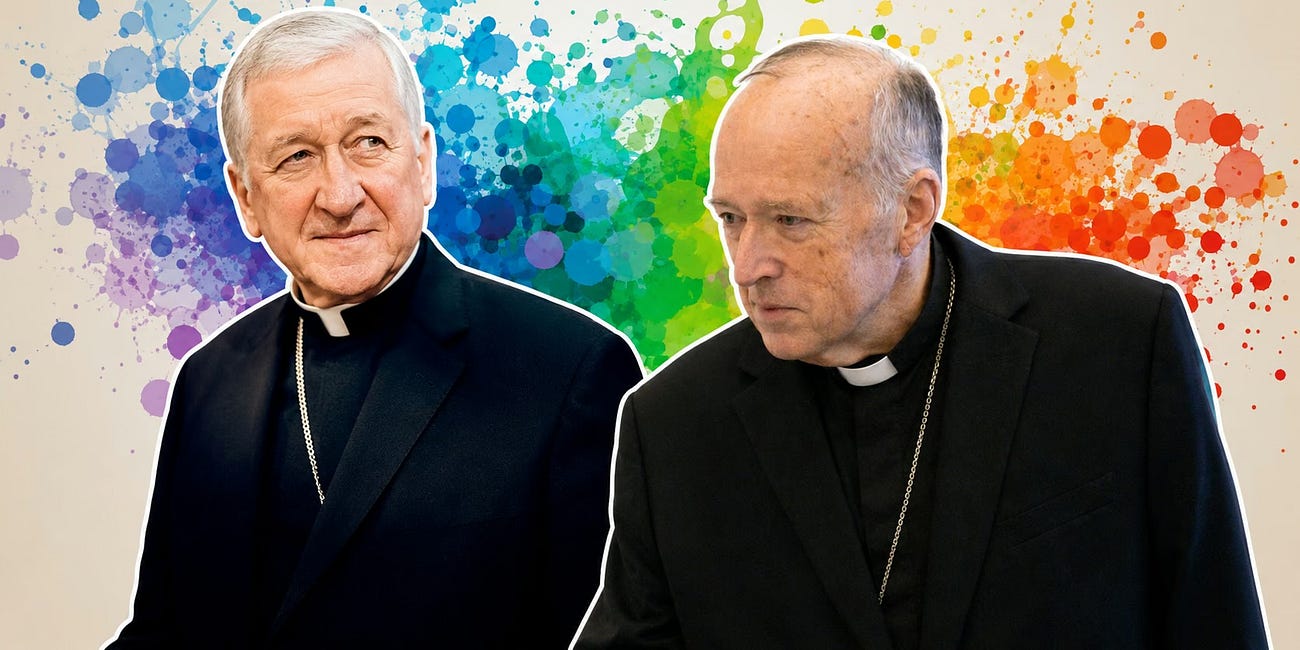
In the Archdiocese of Detroit, restructuring is underway due to lagging Mass attendance. I've written about this before and suggested the solution is not combining parishes and continuing the modernization and secular accommodation, but a return to the mystery of the faith, which in one way is the Traditional (Tridentine) Latin Mass.
Below is an article copied verbatim from Daily Mail that proves my point ... where attendance has tripled.
-------------------
The ornate Catholic church was on the brink of closing... until a priest came up with an extraordinary old-fashioned idea that made attendance boom
By NATASHA ANDERSON, US SENIOR NEWS REPORTER
PUBLISHED: 13:28 EDT, 6 July 2026 | UPDATED: 13:48 EDT, 6 July 2026
An ornate Catholic church was on the brink of closure but now sees hundreds of faithful flock to its pews for Mass each week thanks to a priest's extraordinary idea.
St Francis de Sales Oratory was founded in 1867 by a group of German immigrants who settled in St Louis.
The gorgeous cathedral became a landmark in the midwestern city and for decades served parishioners of more than a dozen nationalities.
But as families started moving out to the suburbs, the church, dubbed the Cathedral of South St Louis, saw a massive drop in parishioners, the church website states.
St Francis de Sales was closed by the Archdiocese of St Louis in June 2005, and the church was forced to merge with another local parish.
St Francis de Sales Oratory in St Louis, Missouri is one of roughly 450 Catholic churches in the US that celebrates the traditional Latin Mass
A typical Sunday will see more than 700 people fill the pews of the cathedral to partake in a nearly two-hour long service where almost no English is spoken.
The choir leads Gregorian chants, the priest faces the altar as he performs the liturgy and communion is distributed at a rail
The priest delivers the homily, or sermon, in English, but the rest of the Mass resembles a traditional ancient service.
The congregation typically sits in silence and female parishioners often wear veils as a symbol of reverence. St Francis does not have air conditioning and gets stuffy in summer - but even that does not deter worshippers, who cool themselves down with fans instead.
Membership at the church has tripled in the last six years, with the majority of parishioners being young families and Gen Z adults.
Parishioners interviewed by the newspaper said that worshipping in Latin has helped them become more connected to their faith.
'When everything was in English, I never had to think twice about what was going on,' 23-year-old parishioner Natalie Spain told the Post-Dispatch.
She claims the 'mystery' of Latin service forced her to be more reverent.
'A lot of us are hungry for something that feels older and more solid,' echoed Philomena Wallace, 26. 'You have a way of worship that extends past the language. The meanings are not changing.'
Membership at the 159-year-old church has tripled in the last six years, with the majority of parishioners being young families and Gen Z adults
St Francis de Sales was scheduled to be torn down and sold in 2005, Cardinal Raymond Leo Burke saved the cathedral by erecting it as an Oratory where Mass is strictly administered in Latin
St Francis de Sales, however, also appeals to Gen X, with one 49-year-old parishioner saying the service was like nothing he'd ever experienced before.
He and his wife, who first visited the church 14 years ago while on vacation from Florida, said it is the best place for 'spiritual nourishment.'
The couple ultimately bought a house in nearby St Francois County and relocated to Missouri with their three young sons.
Rising membership at St Francis de Sales mirrors a global trend in which Catholicism is seeing a resurgence amongst Gen Z.
Older adults make up the majority of Mass-goers, but data collected by the Barna Group last year found that Gen Z frequent services more regularly.
Harvard University’s Cooperative Election Study also showed that the number of Gen Z Americans who identify as Catholic increased from 15 percent in 2022 to 21 percent the following year.
Several Catholic churches have gone viral on social media after receiving praise from so-called Catholic influencers.
St Joseph's Church in Manhattan's Greenwich Village neighborhood was even dubbed one of NYC's Hottest New Clubs after it emerged that queues of more than 100 people wait outside the parish ahead of Sunday service.
15,000 people gathered in Écône, Switzerland, for the SSPX Ordination of four new bishops. The size of the crowd is evidence.
In her "Forward Boldly" podcast, Christine Niles recently proclaimed that the SSPX's claim that the Novus Ordo (NO) Mass is "evil" was "extreme," and therefore, because it was "extreme," SSPX was wrong. Christine went on to explain SSPX's rationale for their "evil" claim. The claim centered on sins of omission, not commission. SSPX does not like the NO Mass because of what it leaves out of the TLM (Tridentine Mass). I agree with SSPX on this. But I had not thought of the sin of ignoring what was previously considered sacred and necessary as evil. SSPX points to a slippery slope. What do we eliminate next? For hundreds of years, and I believe numerous popes, have proclaimed the TLM as sacred and necessary. Now Francis and Leo think it's wrong and should not be celebrated. To me that is extreme.
I came into the church from Protestant Evangelicalism in 1998. One reason was that I could understand the NO, which was celebrated in my English vernacular. But since then, in my Catholic apologetic work and research, I have come to believe that the NO is a rebellion against the reverence of the traditional TLM, and that, by eliminating prayers and acts of reverence and by modern accommodation, it has become sacramentally vulgar...and therefore I have no problem with the SSPX's claim that it is evil.
The NO is priest-centered, not God-centered; it does not respect the Eucharist liturgically (in 100 ways), and by the use of extraordinary ministers, and promoting communion in the hand. The NO is "versus populum" (facing the people) with the priest turning his back to God. This is the explicit expression of the logical fallacy "ad populum" (making accommodation to the people and the masses). Although I’m told "ad orientem" (the priest and people face God) is not strictly forbidden in the NO, our “wonderful” new “Francis” bishop here in Detroit (Wiesenberger) has forbidden it. Some bishops are refusing to let us kneel to receive the body of our Lord. THESE are the EXTREMES. Christine Niles gets it wrong.
The claim of extremes should be directed to the NO and Francis and Leo’s objection to the TLM. But there are more extremes in the NO.
The use of the vernacular is not conducive to worship of God Almighty, when we have a liturgical language (Latin) that is not used anywhere in the secular world. The virtue of Latin is that, unlike vernacular languages, Latin does not change. It's a "dead" language. Vernacular languages contribute to misunderstandings through linguistic and logical fallacies and thus are crucibles for heresies. I've said for years that Protestantism is the consequence of equivocations (misuse of the vernacular).
Compared to chant, the use of popular music is like fingernails on a chalkboard.
I'll say nothing about how people dress and act in the NO vs the TLM. (Well, I guess I did say something.) Yes, the NO could be more reverent, but the tone of Vatican II (V2) and how it has been implemented in the NO promote shorts and flip-flops, indifference to the Eucharist and all things formerly held sacred.
Vatican II, from which the NO evolved, is pastoral, not dogmatic or doctrinal. No new doctrines were defined, nor was a heresy condemned. And yet, Francis and Leo and many bishops act as if V2 is dogmatic, and therefore treat the NO as dogma. But NOTHING out of V2 is dogmatic, so why are we pretending the secular, modernist NO is dogmatic?
I am disturbed by pundits incorrectly calling everything a pope does as "indefectible," which means the pope is unfailing, faultless, and incapable of defect or decay. Traditionis Custodes is not an ex cathedra infallible pronouncement. It was Francis's opinion, no doubt driven by wrongheaded (evil?) influences in the Vatican or his own ignorance of the TLM since he wasn't ordained until after V2 and may have never celebrated or even sat through a TLM.
Consider this. Historically, Popes have issued documents (papal bulls) whereby slavery was authorized as acceptable. [c.f. Nicholas V's Dum Diversas (1452), Nicholas V's Romanus Pontifex (1455), and Alexander VI's Inter Caetera (1492).] Stop with the indefectibility heresy. Popes are sinners like the rest of us. Stop conflating "indefectibility" with infallibility, wherein what has been rare (infallibility) becomes ubiquitous (indefectibility). Yes, you will try to parse the words. But it’s not convincing. Shall we start to enumerate past popes' foibles and sins to make the point? (c.f. the children of Alexander VI, Paul III, and Julius II) Traditionis Custodes will soon be recanted as wrong.
Finally, Cardinal Victor Manuel Fernandez, who has been charged with writing much for Francis (and Leo?), is a disgrace, starting with his authorship as a priest of "Heal Me With Your Mouth: The Art of Kissing." Fernandez's writing of Laudato si is unreadable by anyone with a science background. I’ve tried three times, and my degree in physics makes the document a textbook example of cringe. Fernandez also authored Fiducia Supplicans, which has popularly been interpreted as approval of blessing homosexual unions, though Francis has backtracked that interpretation...and yet Fr. James Martin has done it with immunity.
So, the Vatican is not always a credible source of what is right and wrong. As expected of any human institution, the Vatican, at times (and currently, I claim), bastardizes Jesus' prophecy that the Church would get everything right. I suppose the prophecy that the Church would fall in the last days is coming true.
Critical thinking (comparing and contrasting) with history and truth sustained through the centuries is necessary. Do it. Use it.
As I reflect on the current controversy in the Catholic Church regarding the Latin Mass and SSPX, I recall that the church building in Rocky River, OH, which was my grandfather's church (Rev. Jeremiah Williams, a Free Methodist pastor and circuit riding preacher on horseback) was most recently a SSPX chapel.
This lady is not an intellectual, but she has a pious, fresh, and knowledgeable perspective.
Pam and I attend two different parishes in the Archdiocese of Detroit, depending on our schedule and her voluntary parish responsibilities at both. In recent weeks, we've been inundated with requests to attend parish "Listening Sessions," ostensibly to have the curia listen to our concerns about how the AOD plans to restructure due to (1) shifting populations, (2) declining Mass attendance, and (3) the shortage of priests.
There are 209 parishes in the AOD, divided into 15 planning areas. The various proposed plans, 3 for each area, suggest eliminating certain weekend masses at under-populated parishes (who decides what is under-populated?) and require members to travel as far as 40 minutes from their local parish to another where the sacraments are offered. One plan for our area is shown in the image above, and our two parishes in Novi, MI (St. James and Holy Family), which are only a few miles apart, are both vibrant and unlikely to have their Masses eliminated during the restructuring.
The AOD's description of the problem displayed on their webpage (see image below) is described this way:
Over recent decades, we’ve seen significant shifts: fewer Catholics attending Mass, declining participation in the sacraments, and an ever-shrinking number of priests due to aging and retirement. Once serving 1.5 million Catholics, we now minister to approximately 900,000 — with fewer than half attending Mass regularly. At the same time, we’ve struggled to maintain buildings, structures and ministries designed for a much larger Church, and that’s left us stretched thin — making it harder to fully serve where people need us most.
While I understand the administrative issues surrounding finances and building upkeep, the shortage of priests and fewer people taking the sacraments, these problems will not be solved by demographic and geographic adjustments. The problems are spiritual, not numeric; they are quantum, not deterministic.
I cannot help be reminded of a similar problem faced years ago by the Lutheran church Missouri Synod, of which I had a connection before my conversion to Catholicism. The president of the LCMS declared that the solution to declining attendance was to establish new churches in upstate New York, where the population was historically Germanic and thus (supposedly) more psychologically aligned with Lutheranism. The red flag waving frantically called attention to the lack of the LCMS's attention to the fundamental evangelical nature of the Christian Church—The Great Commission (Matthew 28:16–20) and concern instead with adjusting the demographics and geography, for the purpose of increasing attendance. If Lutheranism (of the Missouri Synod nature) was so good and true, then why not evangelize where the churches were currently located? (The answer to that is book-length, and I'll not try to answer.)
I see in the AOD restructuring effort an embrace of similar blindness. I don't see the solution as physical restructuring but rather spiritual revival. Here are four considerations that, if implemented together, would eliminate the need for the AOD to restructure.
1. Do not restrict priests to only 1 or 2 Masses per day.
Canon Law 905 allows a priest to celebrate up to 1, 2 or 3, even 4 Masses per day, especially on weekends and festivals. Canon Law (905) is not infallible, dogmatic, or doctrinal. To rigidly hold to this restriction without considering the spiritual demands of a parish is to be pharisaical...holding rigidly to a law that harms the more important roles for a priest.
2. Remove all administrative duties from the parish priest and give such duties to a full-time LAY administrator who is trained in or has demonstrated successful organizational leadership in the secular realm.
Acts 6:1-6 establishes the role of a deacon for the purpose of administering the parish, leaving prayer and teaching (and celebrating Mass and sacraments) to the priest (or ordained deacon). I do not think a parish administrator needs to be an ordained deacon, unless seminaries begin granting degrees in Organization Development and Leadership. This move alone would allow priests the time and energy to say more Masses, to pray and study the Word, and administer the sacraments. There are plenty of capable men who can be full-time LAY-administrators who are skilled in organizational development and administration.
3. Remove ALL restrictions EVERYWHERE for celebrating the Traditional Latin Mass.
This alone will attract more people to Mass. A simple census will reveal the GREAT attraction of young professionals and their families to the TLM. When I attend a TLM, I'm amazed by the deep reverence and the presence of young families with many children. They avoid the Novus Ordo for a variety of reasons, one being Vatican II's dismissive attitude toward reverence in the TLM. I believe that the invention of the Novus Ordo has resulted in fewer people taking the sacraments and fewer men considering the priesthood. The Novus Ordo has made common the worship of God. (cf: https://www.youtube.com/c/MassoftheAges)
4. Attract young men to the Priesthood through the mystery of the TLM.
This will solve the shortage of priests. By opening the TLM everywhere and training priests to celebrate the TLM, you will attract more good and intelligent men to the priesthood. The priesthood is special and miraculous. Show young men how special and miraculous worship can be by celebrating the TLM. Avoid the common place of the Novus Ordo rubrics, reinstate ad orientem, chant, Latin hymns, organ, kneeling, communion on the tongue at the rail by ordained men, and the mystery that has been removed by the Novus Ordo (commonly referred to by many as simple "NO.")
5. Reinstate orthodox professors to the Seminary that the Archbishop fired without good cause.
Rejecting these holy men dissuades young men from the priesthood. Arbitrary and questionable decisions by an Archbishop are an offense to young men who want an orthodox faith. Intelligent, clear-minded men, who are called to the priesthood, do not want to pledge obedience to an Archbishop who blindly embraces Post-Vatican II ideology that punishes the centuries-old traditions of the church, and goes so far as to embrace Islam as a valid path to know God, and call Islamic places of worship "sacred." I could easily long to be a priest (although too old now), but I could never promise obedience to our current archbishop. I am sure his woke administrative decisions have turned young, faith-minded young men away from the priesthood in the AOD. Get the archbishop to confession and recant his sinful behavior. Young men will flock to the seminary.
6. The Archbishop (Edward J. Weisenburger) needs to publicly recant and confess as "sin" his decisions that contradict the tradition of Catholic orthodoxy and worship.
Weisenburger's accommodation to political liberalism and the LGBTQ trans community, his demeaning the importance of penance and post-Vatican II "reforms," his embrace of the Synod on Synodality with its shift toward modernism, and his championing of the ambiguous and inclusive pronouncements of Pope Francis (Todos, todos, todos), have turned many devout Catholics away from the church, the sacraments, and financial support of the AOD. Conversion has been replaced by slogans, repentance has been replaced by (DEI) inclusion, and doctrine has been replaced by "lived experience." Weisenburger needs to repudiate all of this and shepherd the Church in Detroit back to the faith. If he does so, God guarantees there will be no need for restructuring.
I copied this short essay from Catholic.com. It is cited (at the end) as written by John Henry Cardinal Newman, from his document: “Prospects of the Catholic Missioner” in Discourses to Mixed Congregations. I am not well-read on this topic, but the term "post-conciliar framework" was used in an essay by Chris Jackson to reference to Pope Leo XIV's recent appointment of a laywoman (Maria Montserrat Alvarado) as Prefect of the Vatican Dicastery for Communication, a position historically held by a male priest. Leo XIV worries me, as did Francis. This essay explains why.
The professional avant-gardists in the Church today never tire of telling us of the Christian faith in the post-conciliar epoch—of the changes called for by the “post-conciliar spirit.” These vague slogans conceal a tendency to replace the infallible magisterium and unchanging faith of the Church with something else, something new. I am reminded of the famous program of the German National Socialist Party, which in paragraph 17 declared that it accepted Christianity insofar as it corresponded to the “Nordic ethos.” In that case too the divinely revealed doctrine of the Church was supposed to subordinate itself to an extremely vague and, moreover, purely natural norm.
John Henry Cardinal Newman
But does not the expression “post-conciliar spirit” refer to the “spirit of Vatican II”? And is it not, therefore, something precise and Christian? But even if this were the intended meaning, the effect would be to represent the Second Vatican Council (the “spirit” of its decrees) as an ultimate norm that is played off against the former Councils—above all, against the Council of Trent. Now, the moment one implies that one council has rendered others outmoded, irrelevant, the question immediately arises: Whence does one derive the conviction that the truth of the Holy Spirit is to be found more in this council than in others? In the first place, even if a council could err in its dogmatic definitions, there is no reason to suppose that the latest council is less exposed to error than former ones.
But, of course, any contradiction in defined dogma is incompatible with the infallible magisterium of the Church. Any implication, therefore, that Vatican II has in any way abrogated dogmatic expositions of former councils calls into question the divine institution and perpetual guarantee of the Catholic faith. Furthermore, the Second Vatican Council made no dogmatic definitions: Its purpose was strictly pastoral in nature. And Vatican II declared expressis verbisthe continuity of the “spirit” of its utterances with that of former councils. The Holy Father gave a clear answer to those who wish to treat Vatican II as a kind of beginning of the authentic Christian revelation, as a new norm against which the teachings of former Councils must be measured: “The teachings of the Council do not constitute a complete, organic system of Catholic doctrine. Doctrine is much more extensive, as everyone knows, and it is not called into question by the Council nor substantively modified” (Address of Pope Paul VI, Jan. 12, 1966).
But in reality the propagators of the “post-conciliar spirit” do not truly identify it with the spirit of the decrees of Vatican II. The term itself—”post-conciliar spirit,” “post-conciliar Church”—clearly suggests that something quite different is meant. Often this is openly and frankly admitted as at the [1967] Toronto Congress, where the Vatican Council was seen by some speakers as only a beginning but as not fully expressing the “post-conciliar spirit.” In fact, this conveniently vague notion has no basis in the infallible magisterium of the Church. It represents, rather, a mentality nourished by historical relativism and at the service of that fictional creature “modern man.”
Yet, the “post-conciliar spirit” cannot justly designate the state of the Church after Vatican II, for no one can deny that there are contradictory currents within the framework of the Church today, not one trend that embraces all Catholics. Thus, it is not even possible to speak of a “post-conciliar spirit” that is analogous to the “post-Tridentine mentality.” The Council of Trent imposed through its precise and emphatic definitions of faith a lucid unity of spirit on the hierarchy, clergy, and all the faithful, a spirit that stamped the time which we know today as the Counter-Reformation.
If we wish to know precisely in what the new modernism that calls itself the “post-conciliar spirit” consists, we have only to turn to the numerous warnings of the Holy Father. If we examine the speeches and writings of the heralds of the “post-conciliar spirit,” we shall find that the real content of this spirit is the desire to conform to “modern times,” “the scientific age,” to “man come of age.” (Of course, the new norm is as much a mere speciality of a single epoch as the National Socialist “ethos of the Nordic race” was a specialty of a single people.)
This modernization of the Church is put forward as an attempt to deepen the truth of Christian revelation, to free the deposit of Catholic faith of “mythological elements.” But in making the alleged mentality of our epoch the criterion of the faith, these post-conciliar spirits are only replacing the perennial faith with short-lived and often self-contradictory slogans. The fashionable theories that fill the air are usually no more than sophisticated superstitions. In choosing these as the norm for their alleged deepening of the Christian truth, the post-conciliarites have, in reality, set the wolf to mind the sheep.
Perhaps the most pervasive manifestation of the “post-conciliar spirit” is the unrestricted freedom many assume in the discussion of religious matters, a penchant for re-examining the dogmas, instead of accepting the deposit of Catholic faith as transmitted infallibly by the Church. But when these post-conciliar persons assert that the Church must be adapted to the mentality of our epoch, they had in mind meeting all the objections that are made against the Church—notionly by the Protestant denominations but also by the “world.” The deepest desire of some of our progressives seems to be to measure up in the eyes of the world. But this attitude in no way grows out of a genuine thirst for truth, but comes, rather, from an unwarranted respect for the opinions of the world and from fear of the world’s censure; it comes from having chosen to replace the infallible magisterium of the Church with certain contemporary opinions.
The absurdity of all these perversions of the faith is most flagrant in those who assert that they are deepening the truth, after first having proclaimed that there is no “static truth.” This self-contradictory position, born out of radical historical relativism, would (if it were possible to take it seriously) make all striving for truth senseless, the appeal to truth an empty gesture, and faith and religion utterly meaningless.
Of course, the unchangeable character of the Church is a scandal to the world and the worldly. But the Catholic should rather affirm this unchangeableness as a sign of her supernatural foundation: “Lo! The fair form of the ancient Church rises up at once, as fresh and vigorous as if she had never intermitted her growth. She is the same as she was three centuries ago, ere the present religions of the country existed, you know her to be the same; it is the charge brought against her that she does not change; time and place affect her not, because she has her source where there is neither place nor time, because she comes from the throne of the Illimitable Eternal God”
(John Henry Cardinal Newman, “Prospects of the Catholic Missioner” in Discourses to Mixed Congregations).
Last night, I was the guest on Dave Scott's "Spaced Out Radio," a live terrestrial radio program out of British Columbia, Canada that is heard on 8 stations around the U.S., and later posted on YouTube.
The impetus was the new trilogy edition of my historical novel, Wizard Clip Haunting, and its paranormal storyline. We had a great time and talked for 2 hours (with station and commercial breaks) about the juxtaposition of the natural and supernatural, the paranormal and the normal.
Dave has an avid nightly following talking about American and Canadian Ghost Stories, Paranormal True Encounters, Real History, UFOs, and Big Foot. He's located in the wilderness between the Cascade Mountains and the North Rocky Mountains (God's country).
Below is the YouTube version of the podcast, complete with off-air chatter and the silence during terrestrial radio station breaks.
Related to this is my Nineveh's Crossing blog post "Is Christianity Paranormal" which contains links to posts on the same subject from Amanda Arrows, and Fr. Dwight Longenecker.
This is for ours and your grandchildren, who are faced with life choices and divine opportunities, and yet, sometimes, in some ways, they (and we) are fearful of stepping out and working hard enough to go after and embrace that opportunity... because they could fail, or because they fear the hard work that it will require.
WHERE I COME FROM
There are times when, as much as I appreciate my Christian upbringing and the Church, I recognize that I’ve lived a sheltered life. For the most part, that’s a good thing, a necessary thing, a salvation thing.
But as Lew Wallace writes in Ben Hur, in the voice of Miriam, mother of the titular character Judah Ben Hur, Jews have no artists, poets, or warriors like the Romans. But they have something better, the artist of creation, God, as exemplified in the art and craftsmanship of Bezalel and Aoholiab (Wallace’s spelling) from Exodus 31 ff who created Israel’s temple and all its gold statuary, elaborate ornaments.
I wasn’t Jewish, but growing up in Evangelicalism (that bordered the separatist of Christian Fundamentalism), there was a distinct aversion to many forms of artistic expression. The conservative Christian fellowships I grew up in might be brave enough to frame an image of Warmer Sallman’s Head of Christ, but if a real piece of art found its way into the building, there was a passionate impulse by the leaders to plaster the words of a Bible verse across the work in an effort to make it sacred, or ensure the art found its way to a waste bin, or was painted over with pale green wall paint (all true stories, see my memoir, Growing Up Christian). I always found this offensive. My favorite Psalm, which grandson Michael and Rachel asked me to read during their wedding three weeks ago, declares:
The heavens declare the glory of God;
the skies proclaim the work of his hands.
Day after day they pour forth speech;
night after night they reveal knowledge.
They have no speech, they use no words,
no sound is heard from them.
Yer their voice goes out into all the world,
their words to the ends of the world.
—Ps 91:1–4
God does not plaster the words of Scripture across the heavens or the bark of trees. Although a study of astronomy from the perspective of the Bible reveals that the signs of the zodiac were known to Job (38:31-32), David (above), and Moses (Genesis 1:14). And there is Mel Morris's 25-part series, The Bible in the Heavens and the Gospel in the Stars, which explains with clarity how the zodiac signs depict the coming of Christ and the Gospel. (e.g. Virgo—Virgin Birth, Libra—Price of Redemption, Scorpius—Conflict between the Messiah and Satan, Leo—the Tribe of Judah and Christ's victorious return).
God does not need pat sermons or sweet devotionals to get the truth out. He often proclaims what is good, true, and beautiful in ways that are so obvious we miss them, or we take for granted, and sometimes we find them offensive. (c.f. Angel Quest)
The latest example, in my experience, is "Lose Yourself," the Eminem rap that was the theme song of his 2002 semi-autobiographical Detroit movie “8 Mile,” and which won an Oscar in 2003 for Best Song. The song ranked in the charts for decades and was a 20+ platinum record (a platinum record is 1 million units sold).
Last night (May 22, 2026), I felt the heavy ping of being sheltered when I came across a video on YouTube of opera singer, Maria Fiselier, covering “Lose Yourself” on a Dutch TV show...rap as opera is an ironic hook). I listened to it several times but then only caught a smidgen of the lyrics. Later I found them (below). “Lose Yourself” is an inspirational recording for anyone afraid to step out and embrace an opportunity—articulated in the song’s refrain:
You better lose yourself in the music
The moment, you own it, you better never let it go (Go!)
You only get one shot, do not miss your chance to blow
This opportunity comes once in a lifetime, yo
In the movie (8 Mile) the story and the rap are both about rap contests in Detroit’s inner city. But broadly, they are metaphors for every obstacle and opportunity in life. There is much to learn here about working hard to embrace opportunities without fear. The heavy rhythmic beat in the song reinforces the importance of perseverance. You better lose yourself in the music of life...that is, persevere.
Here is Maria Fiselier’s cover of "Lose Yourself (clearer lyrics but not cleaner.)
Eighteen years after "Lose Yourself" won an Oscar, Eminem performed “Lose Yourself” live at the 2020 Oscars. Here’s the link. His segment begins at 2:53.
Christianity, especially the Catholic variety, is very much part of what secular culture refers to as the "paranormal." But, of course, the integrity of such a claim depends on how one defines paranormal.
The paranormal of our secular, cultural milieu consists of ghosts, demons, poltergeists, pervasive evil, and vile reports of demonic possession. Generally, Christianity wants nothing to do with any of that...at least the kind of Christianity into which Pam and I were raised, which was Protestant Evangelical verging on Fundamentalism, as humorously described in our memoir Growing Up Christian.
My Evangelical-Fundamentalist background was filled with mysticism—communicating with God and seeing dramatic answers to prayer, quickened by understanding that the supernatural, invisible realm (e.g., the paranormal realm) was real. And now that we're Catholic, we've grown used to saints hovering about our heads and talking to St. Anthony of Padua (the patron saint of lost things) on an hourly basis.
Even though I spent the first years of my professional career as a physicist training NASA astronauts, I have always believed in the invisible realm of angels and demons. I make the argument elsewhere that my study of science reinforced my belief in what was invisible—should we start with the deep cosmos or with quanta atoms?
Wikipedia defines Paranormal Activity as "purported or imagined phenomena...beyond the scope of normal scientific understanding," e.g. telepathy, premonitions, clairvoyance, demonology, exorcisms, ghosts and ghost hunting, occultism, telekinesis, apparitions, spiritism, miracles, precognition, and various poltergeist activity.
Despite my sheltered Christian life growing up, the secular world's understanding of the paranormal milieu never shocked me. If I ever thought much about it, which I rarely did, I just thought it was incomplete and immature. As a junior at a Christian college, living in an old campus house that resembled a fraternity, beer and Greek letters over the front door were not allowed unless it was a quote from the Greek New Testament about Jesus making wine. (I always wondered if Jesus ever sampled the wine he made. WDYT? I digress.) My roommate was a mathematician who became a celebrated professor at a major university. Yet, across the hall was a room full of sociology majors who began experimenting with a Ouija Board. It didn't turn out well for them, and an ambulance was called. I believed in all that stuff as much as the Devil believes in God. He does, but stays away from the Almighty, and I did, but stayed away from the occult.
But in just the last year, the realization of how Christianity and the paranormal are bedfellows (can I say that?), came to the forefront when I struck a deal with Defiance Press to help with the distribution and marketing of my historical novel, Wizard Clip Haunting (WCH). The first edition (published through my niche entity Nineveh's Crossing) sold several hundred copies in various formats. But something was missing, not necessarily from the 372,000 word novel, but from my ability to reach an audience. In part, it is too haunting for Catholics and too Catholic for horror fans.
Lisa Woodward, Director of Publishing at Defiance Press, quickly recognized the flaw in my thinking. Defiance's motto is: "Rooted in Faith. Driven by Patriotism. Published with Purpose." I thought my target audience was American historians and Catholics, although I actually knew Catholics were not my audience, since, for the most part, Catholics don't read. I also thought WCH might be part of the horror genre, but I was not a horror consumer (except for reading Flannery O'Connor) and was ignorant of how to approach such readers.
Lisa understood the obvious, of which I was oblivious. WCH is infused with descriptions of historically documented Early American paranormal activity in a Catholic setting. That the secular paranormal audience was a vast and large community, I had no idea.
In the past week, in anticipation of the release of my new trilogy edition of WCH, Lisa launched a pre-publication marketing campaign to an industry I did not know existed. I'm now preparing to be a guest on several paranormal YouTube podcasts.
Paranormal investigations and investigators of the supernatural have flourished for centuries. Most notably, in 1944, Lorraine Rita Moran (16) met Ed Warren (17) at the local playhouse, where Ed was an usher. A year later, they were married. Both Roman Catholics had little trouble believing in spirits and were convinced that people who were weak in their faith would be subjected to demonic influences and even possession. Stories of their investigations have them readily gripping their rosaries and praying for protection.
In 1952, the Warrens founded the New England Society for Psychic Research (NESPR), which is the oldest ghost-hunting group in New England. And the rest, they say, is history for the cult-like community of paranormal researchers and investigators in the United States.
To help attract that crowd, Lisa put a tag line on the cover of my books: "Before Amityville, Before the Warrens...there was Wizard Clip." If you haven't guessed, "The Amityville Horror" story and the Warrens live at the heart of paranormal investigations. Lisa knew that, but I didn't. (Last week, I finally read The Amityville Horror, which I found poorly written but ironically very popular, which tells us something about culture.)
What I did know, but did not associate with "paranormal activity," was all the scientifically unexplained events and stories described throughout Judeo-Christian scriptures and literature. The Bible is filled with paranormal activity. In the Old Testament, we have Noah's premonition to build an ark that took 120 years, the plagues of Egypt, Moses parting the Red Sea, Elijah disappearing into the sky aboard a fiery chariot, the walls of Jericho falling down, Joshua commanding the sun to stand still during a battle against the Amorites, and a host of other strange events. In the New Testament, we have a myriad of miracles performed by Jesus and the Apostles—healings, food production, raising the dead, prophecies, Christ's resurrection, and the vast and pervasive descriptions in John's Revelation. Although a few have tried (Immanuel Velikovsky comes close), scientific explanations are hard to come by. Then, in modern history, we have the apparitions of saints witnessed by thousands, especially Mary; the bilocation of saints like Padre Pio; apparitions of angels like St. Michael (see my documentary,Angel Quest); and an untold number of visions and miraculous answers to prayer.
The merging in my mind of these two seemingly diverse disciplines (science and spirit) was aided by my understanding that there is no contradiction between natural science and the Bible—both are simply different expressions of truth, goodness, and beauty by the same author.
Thus, while investigating and writing WCH, everything that happens in the story, to me, is scientifically and spiritually cogent. They are all a normal part of reality, though one that science cannot explain.
So, there you are: Wizard Clip Haunting—a case study of paranormal activity in American history.
Lisa is lining up interviews for me with podcasters who normally interview paranormal investigators, some who claim to be clairvoyants, mediums, psychics, and animists. I am none of those, all forbidden by Judeo-Christian morals. But I've been forced to reconsider that within the rubrics of Christianity, I am most certainly a paranormal investigator and believer in the supernatural. My YouTube documentary, Angel Quest, is a good example. It was a pilgrimage of investigation into the line of St. Michael monasteries and an investigation into the apparitions and supernatural activities that can easily be classified as angelic paranormal phenomena.
[Amanda's post begins with a video of a Catholic Spanish street procession featuring hundreds of robed and hooded men carrying large platforms adorned with heavily symbolic statues on their shoulders. Some men wear tall, pointy white hats; others wear black silk robes and hoods. The caption says it all: "This looks and feels demonic..."]
In rapid fire, Amanda explains:
"I understand I get it, the candles the incense, the relics the priest and robes, the prayers that sound like we might be talking to the dead...if you have a very basic surface level understanding of Catholicism, I understand your confusion. But the reason why the occult and Catholicism look similar to an outsider is because the occult only imitates what is sacred. Satan does not invent, he counterfeits." (Amanda lifts into view a white mug with an image of Our Lady decoratively imprinted on the front (she sells them...it's a product placement...but Amanda doesn't slow down.) "And the only reason why he has something to counterfeit is because something real exists to begin with. Here's the difference. The occult tries to access or control hidden powers for human gain, but Catholicism is not about control, it doesn't try to control anything. It's about complete surrender, surrendering your entire existence to God through Christ. I'm going to throw out a few examples [with visual inserts]. Candles for the occult are used for magic, but in Catholicism it's (they're) actually a visible prayer. Rituals for the occult are for manipulation; they are for personal gain. In Catholicism, it (ritual) is all about ordered worship [nice pix of the TLM]. The occult may use relics as physical objects, maybe gems something like that, that (supposedly) hold power or they even are seen as enchanted. The relics that we have in Catholicism are honored because of God's work in them. All of that, what I am trying to say, is that the focus is always on God, his authority, his will. And the only reason why it may look similar on the outside is because the occult is always trying to distort the sacred. Why do you think so many horror movies are based on Catholicism, and what we have is sacred? They're distorting it. Catholicism does not borrow from darkness. Darkness looks like Catholicism because it is the counterfeit of what is sacred. If I can sum this whole thing up, it would be a quote from Saint Augustine. He said (paraphrasing), "The human heart was made for God, and when it does not find the real thing, it reaches for substitutes." The occult fills a god-shaped void with darkness, and the Catholic Church fills it with truth, beauty, and light, and only ever points us towards the goodness and grace of God."
ADDENDUM 2A
On May 21, 2026, I was interviewed by Dave Schrader of Paranormal 360 (and aired on The Paranormal 60 network).
ADDENDUM 2B
On May 27, 2026, I was the guest on Dave Scott's "Spaced Out Radio," a live terrestrial radio program out of British Columbia, Canada that is heard on 8 stations around the U.S., and later posted on YouTube.
The impetus was the new trilogy edition of Wizard Clip Hauntings and its paranormal storyline. We talked for 2 hours (with station and commercial breaks) about the juxtaposition of the natural and supernatural, the paranormal and the normal.
What we are dealing with is a complicated human experience that has more to do with the way we perceive and process reality than with any concrete, objective, physical reality. The experiences overlap with apparitions of the Blessed Virgin, apparitions of the dead, angel experiences and other paranormal experiences.
I replied to him that his post was an apt summary of my two hours with Dave Scott. "Keep it up." I told him.