Showing posts with label Pope Francis. Show all posts

Thursday, July 2, 2026

The Dogma of Extreme - SSPX vs Leo XIV's Vatican

15,000 people gathered in Écône, Switzerland, for the SSPX Ordination
of four new bishops. The size of the crowd is evidence.


In her "Forward Boldly" podcast, Christine Niles recently proclaimed that the SSPX's claim that the Novus Ordo (NO) Mass is "evil" was "extreme," and therefore, because it was "extreme," SSPX was wrong. Christine went on to explain SSPX's rationale for their "evil" claim. The claim centered on sins of omission, not commission. SSPX does not like the NO Mass because of what it leaves out of the TLM (Tridentine Mass). I agree with SSPX on this. But I had not thought of the sin of ignoring what was previously considered sacred and necessary as evil. SSPX points to a slippery slope. What do we eliminate next?  For hundreds of years, and I believe numerous popes, have proclaimed the TLM as sacred and necessary. Now Francis and Leo think it's wrong and should not be celebrated. To me that is extreme. 

I came into the church from Protestant Evangelicalism in 1998. One reason was that I could understand the NO, which was celebrated in my English vernacular. But since then, in my Catholic apologetic work and research, I have come to believe that the NO is a rebellion against the reverence of the traditional TLM, and that, by eliminating prayers and acts of reverence and by modern accommodation, it has become sacramentally vulgar...and therefore I have no problem with the SSPX's claim that it is evil. 

The NO is priest-centered, not God-centered; it does not respect the Eucharist liturgically (in 100 ways), and by the use of extraordinary ministers, and promoting communion in the hand. The NO is "versus populum" (facing the people) with the priest turning his back to God. This is the explicit expression of the logical fallacy "ad populum" (making accommodation to the people and the masses). Although I’m told "ad orientem" (the priest and people face God)  is not strictly forbidden in the NO, our “wonderful” new “Francis” bishop here in Detroit (Wiesenberger) has forbidden it. Some bishops are refusing to let us kneel to receive the body of our Lord. THESE are the EXTREMES. Christine Niles gets it wrong.

The claim of extremes should be directed to the NO and Francis and Leo’s objection to the TLM. But there are more extremes in the NO.

The use of the vernacular is not conducive to worship of God Almighty, when we have a liturgical language (Latin) that is not used anywhere in the secular world. The virtue of Latin is that,  unlike vernacular languages, Latin does not change. It's a "dead" language. Vernacular languages contribute to misunderstandings through linguistic and logical fallacies and thus are crucibles for heresies. I've said for years that Protestantism is the consequence of equivocations (misuse of the vernacular).

Compared to chant, the use of popular music is like fingernails on a chalkboard. 

I'll say nothing about how people dress and act in the NO vs the TLM. (Well, I guess I did say something.) Yes, the NO could be more reverent, but the tone of Vatican II (V2) and how it has been implemented in the NO promote shorts and flip-flops, indifference to the Eucharist and all things formerly held sacred. 

Vatican II, from which the NO evolved, is pastoral, not dogmatic or doctrinal.  No new doctrines were defined, nor was a heresy condemned. And yet, Francis and Leo and many bishops act as if V2 is dogmatic, and therefore treat the NO as dogma. But NOTHING out of V2 is dogmatic, so why are we pretending the secular, modernist NO is dogmatic? 

(see https://www.youtube.com/c/MassoftheAges)

I am disturbed by pundits incorrectly calling everything a pope does as "indefectible," which means the pope is unfailing, faultless, and incapable of defect or decay. Traditionis Custodes is not an ex cathedra infallible pronouncement. It was Francis's opinion, no doubt driven by wrongheaded (evil?) influences in the Vatican or his own ignorance of the TLM since he wasn't ordained until after V2 and may have never celebrated or even sat through a TLM. 

Consider this. Historically, Popes have issued documents (papal bulls) whereby slavery was authorized as acceptable. [c.f. Nicholas V's Dum Diversas (1452), Nicholas V's Romanus Pontifex (1455), and Alexander VI's Inter Caetera (1492).] Stop with the indefectibility heresy. Popes are sinners like the rest of us.  Stop conflating "indefectibility" with infallibility, wherein what has been rare (infallibility) becomes ubiquitous (indefectibility). Yes, you will try to parse the words. But it’s not convincing. Shall we start to enumerate past popes' foibles and sins to make the point? (c.f. the children of Alexander VI, Paul III, and Julius II)  Traditionis Custodes will soon be recanted as wrong.

Finally, Cardinal Victor Manuel Fernandez, who has been charged with writing much for Francis (and Leo?), is a disgrace, starting with his authorship as a priest of "Heal Me With Your Mouth: The Art of Kissing." Fernandez's writing of Laudato si is unreadable by anyone with a science background. I’ve tried three times, and my degree in physics makes the document a textbook example of cringe. Fernandez also authored Fiducia Supplicans, which has popularly been interpreted as approval of blessing homosexual unions, though Francis has backtracked that interpretation...and yet Fr. James Martin has done it with immunity. 

So, the Vatican is not always a credible source of what is right and wrong. As expected of any human institution, the Vatican, at times (and currently, I claim), bastardizes Jesus' prophecy that the Church would get everything right. I suppose the prophecy that the Church would fall in the last days is coming true. 

Critical thinking (comparing and contrasting) with history and truth sustained through the centuries is necessary. Do it. Use it. 

Wednesday, June 24, 2026

One Non-Intellectual but Pious Experience with SSPX

As I reflect on the current controversy in the Catholic Church regarding the Latin Mass and SSPX, I recall that the church building in Rocky River, OH, which was my grandfather's church (Rev. Jeremiah Williams, a Free Methodist pastor and circuit riding preacher on horseback) was most recently a SSPX chapel. 

This lady is not an intellectual, but she has a pious, fresh, and knowledgeable perspective.


Saturday, June 20, 2026

Will You Help Me Find My Schism?


Intro
Yeah
They kicked in the chapel door
Looking for schism
Found a veil, a missal
And six kids eating donuts
Uh oh

Chorus
Will you help me find my schism?
I think Rome left it on the floor
They searched the Latin chapel
Then blessed Georgetown next door

Will you help me find my schism?
They said it’s somewhere in the pew
But the rainbow conference got a cardinal letter
And a “Holy Spirit” stamp too

Todos, todos, todos
Everybody come on in
Except the folks with old missals
That’s apparently the sin

Verse 1
Cardinal Bob wrote a love note
Said the Spirit would attend
At a conference full of buzzwords
Where the doctrine likes to bend

Cupich sent a greeting card
With a Chicago velvet smile
“Walking side by side,” he said
For about five synodal miles

They got badges, they got lanyards
They got panels on the floor
They got “lived experience”
Beating doctrine two to four

Then Grandma brings her rosary
And whispers “Kyrie eleison”
Rome jumps out the bushes yelling
“Call Fernández, seize the reason!”

Chorus
Will you help me find my schism?
I think Rome left it on the floor
They searched the Latin chapel
Then blessed Georgetown next door

Will you help me find my schism?
They said it’s somewhere in the pew
But the rainbow conference got a cardinal letter
And a “Holy Spirit” stamp too

Todos, todos, todos
Everybody come on in
Except the folks with old missils
That’s apparently the sin

Verse 2
Study Group Nine came rolling in
With a binder full of haze
Said doctrine’s pre-packaged now
And experience gets a raise

They put sin in the suggestion box
They put Scripture on a slide
They put “journey” in the driver’s seat
And let the commandments ride

At Georgetown, they say “listen”
At Écône, they say “halt”
At Outreach, it’s the Spirit
At the old Mass, it’s assault

They can nuance every rainbow
Till the catechism faints
But a priest says “Introibo”
And they’re rounding up the saints

Chorus
Will you help me find my schism?
I think Rome left it on the floor
They searched the Latin chapel
Then blessed Georgetown next door

Will you help me find my schism?
They said it’s somewhere in the pew
But the rainbow conference got a cardinal letter
And a “Holy Spirit” stamp too

Todos, todos, todos
Everybody gets a chair
Unless you chant the Credo
Then security’s over there

Verse 3
Argentina thanked the courage
Of the lady with the scarf
Green as springtime, red as warning
Somehow bishops missed that part

They remembered all the slogans
They remembered all the pain
They forgot the little babies
And the blood behind the campaign

They can spot a schismatic
At three hundred yards in lace
But abortion’s just a footnote
When it wears a left-wing face

Give a speech on human rights
Get the incense and applause
Ask for the old religion
And they hit you with the laws

Chorus
Will you help me find my schism?
I think Rome left it on the floor
They searched the Latin chapel
Then blessed Georgetown next door

Will you help me find my schism?
They said it’s somewhere in the pew
But the rainbow conference got a cardinal letter
And a “Holy Spirit” stamp too

Todos, todos, todos
Hear the happy slogan ring
Everybody means everybody
Minus those before the spring

Bridge
They got mercy for the movement
They got mercy for the trend
They got mercy for the bishop
Who can’t tell where morals end

They got process for the Germans
They got smiles for every fight
They got dialogue for everyone
Who attacks the Church from left to right

But a chapel full of families
With a missal and a bell
Gets a Roman SWAT team memo
Saying, “See you folks in hell”

They kicked down the chapel door
Looking for rebellion
Found three altar boys, a potluck
And a dad in a Suburban

They said, “Where’s the danger hiding?”
I said, “Maybe down the street
Where the cardinals wrote endorsements
For the sexual retreat”

Final Chorus
Will you help me find my schism?
I think Rome left it on the floor
They searched the Latin chapel
Then blessed Georgetown next door

Will you help me find my schism?
They said it’s somewhere in the pew
But the rainbow conference got a cardinal letter
And a “Holy Spirit” stamp too

Todos, todos, todos
Let the slogan do its dance
If you’re anything but trad
You get a fifty-second chance

Outro
So please repair the chapel door
You broke it hunting ghosts
The schism wasn’t hiding there
It’s wearing Roman posts

You found a missal and a mantilla
You found donuts after Mass
You found kids who know the Sanctus
And a dad low on gas

Meanwhile down at Georgetown
They got bishops on the bill
Saying “Come on, Holy Spirit”
While the doctrine sits still

Will you help me find my schism?
Maybe check the VIP room
Where the fog machine is running
And the synod flowers bloom.

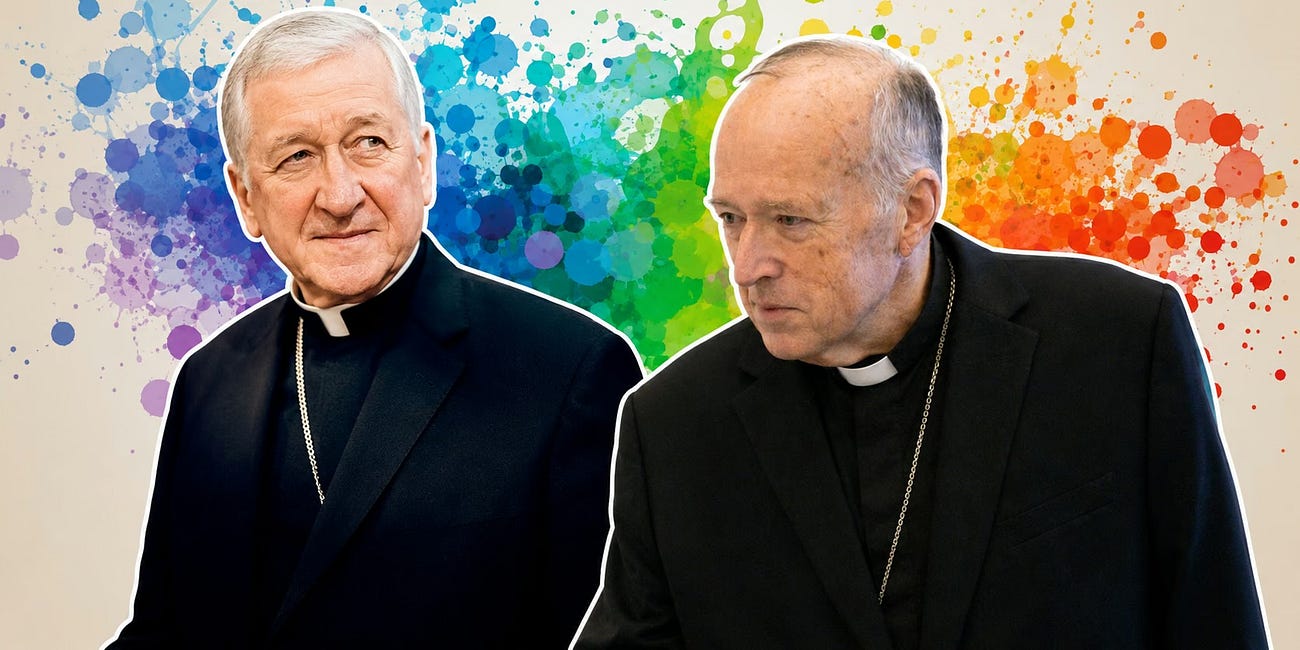
Read the article that inspired it here:

McElroy Says Leo Deepens Francis’ LGBT Project While Rome Looks to Excommunicate Every SSPX Priest

·
9:35 AM
McElroy Says Leo Deepens Francis’ LGBT Project While Rome Looks to Excommunicate Every SSPX Priest

McElroy Welcomes Outreach to Washington

Read full story

Monday, October 7, 2024


An Instagram follower asked some questions (in red below) about Catholicism. I asked that he write contact me via email, since the answer was too long for an IG comment. He did. Below is my answer.

Hi JR,

A bit about me and then I’ll try to answer questions you posed.  This will be long…but no apologies…well, it is an apology, of sorts…a defense of the Catholic faith.

My comments below, aside from my personal story, are the teachings of the Church, as best as I can explain them. They are NOT MY personal opinion. I hope to only convey what the Church teaches, not my own interpretation of Christianity. IMHO the buck stops with the Catechism of the Catholic Church (CCC), which is on-line and searchable ( https://www.usccb.org/sites/default/files/flipbooks/catechism/
Paperbacks and hardbacks are also available from most booksellers.

The CCC documents the centuries old evolved theology of the Church, it can be complicated, although historically well footnoted and referenced, and so there are trustworthy organizations who can explain Catholic teachings in plain language, and better than me, such as: https://www.catholic.com/

My  wife and I were born and raised in functional Evangelical Christian homes in Michigan. Our relationship with Christ has always been very personal from childhood. We raised 3 children and now have 10 grandchildren. All but one of our children and grandchildren and still Evangelical Christians. The story for our switch to Catholicism is long and humorous. I’m a writer and filmmaker and together Pam and I wrote a book about it. https://stanwilliams.com/NINEVEHSCROSSING/Order-GUC.php
I don’t need to sell the book to you. If you like I’ll give you a paperback or PDF.

The switch to Catholicism had all the normal doubts, as you expressed in your Instagram post: “I just don’t get the whole Pope obsession and worshipping Mother Mary aspect of Catholicism. Focus on Jesus.”

Those are honest issues and ones both Pam and I had, originally. 

But to back up, for me, I didn’t come to Catholicism because I “got” the Mary thing or the Pope thing. I have always been trying to figure out what church was the true Church. Being raised in a Bible believing (Jesus) home, I never doubted the authenticity of Christ as God incarnate, or the Gospel message, or the trustworthiness of the (Protestant) Bible. My faith was always strong, and even today as a Catholic my trust in the Bible or Christ has not wained, but in fact (as a Catholic) grown stronger. 

My break from Evangelicalism came in my late 40’s when I decided to resolve a life-long Christian contradiction. The problem I had, and had recognized from my teen years, was that there were multiple Evangelical and Protestant faith traditions (Baptist, numerous varieties), Methodists (several different kinds), Lutherans (there are 120 different Lutheran groups), and then a horde of different other Evangelical groups (my family was Free Methodists, which is very similar to Wesleyan Methodists, and Nazarenes.) 

What I realized in my teen years is that THEY ALL DISAGREED WITH EACH OTHER ON THE ESSENTIALS OF SALVATION, WORSHIP, DOGMA, AND PRACTICE. Yet, they all claimed to be led by the Holy Spirit in interpreting the Bible. But their detailed interpretations were all subtly different and fights and divisions broke out among the groups over these things. They didn’t disagree on the “non-essentials” as they often claimed. They refused to fellowship and worship with each other. Their disagreements were essential issues, to them. They disregarded Jesus’ prayer in John 17 that Christians all be ONE so the world would know that God the Father had sent his son into the world. But we weren’t one. We are separated and fighting. In my first 50 years of life I lived thorugh several church splits, mostly among independent churches, when the people and the pastor disagreed on what the Bible taught. It was an amazing contradiction to me, and not a paradox.

The disagreements continue to this day and are exacerbated on social media posts like TikTok and IG.

When our children became adults, moved out, got married, and had children of their own... I had time to contemplate and research the Protestant (protesting) problem. I decided the Holy Spirit was not schizophrenic; we Evangelical Christians were. But who was right? As I had before, I started church hoping, talking to theologians, and reading various protestant church documents. I was amazing how they all disagreed and yet claimed to only disagree on the non-essentials. I did that for 2 1/2  years, each Sunday always going to church (somewhere), always reading my Bible and praying, et al. My wife, Pam, continued at the independent church we had raised our children at…two of them ended up marrying out of the teen youth group there, and where the still attend yet today. 

One day, (during my 2 1/2 years of research) out of frustration, and having avoided Catholicism, I walked into the local Catholic Church. Actually, there were 5 nearby Catholic parishes. I walked into the closest one and attended Mass. What happened in the next three weeks surprised me. Several of the things I had been told about Catholicism were clearly false. 

(1) They didn’t read the Bible….yet the first half of every (Novus Ordo) Mass is all Scripture from the OT, Psalms, NT Epistles, and a Gospel.   

(2) Catholics don’t know what they believe…yet everyone in the congregation (which was large) recited the Nicene Creed without having to read the text….except me. I was familiar with the Nicene Creed (which is longer than the Apostles Creed) but I didn’t know it by heart and I was embarrassed. 

(3) Catholics worshiped saints (and Mary) and not Jesus…except the entire Mass was centered around the person and sacrifice of Jesus Christ, who was invoked more than 50 times during the Mass 
 
(4) Catholics are into repetitive ritual and just go through the motions…I think this can be true for many Catholics, just as it is for Protestants, the rituals are just different. Some Evangelicals today will sing the same 8 word lyrics in a praise song, 50-60 times, invoking the idea of “vain repetitions.”  But the second half of the Mass, while all ritual, caught my attention because it was essentially a 30-minute prayer (of articulate and uplifting words) in worship to Jesus Christ... for his sacrifice, his salvation, his grace, and God’ mercy, all ending in communion ("For as often as you eat this bread and drink the cup, you are proclaiming the death of the Lord, until he comes again"  - 1 Corinthians 11:26… and yes, the second half of the Mass is almost all Scripture as well.) 

That began my 8-month investigation into the dogma, doctrine, practices, and devotions of the Roman Catholic Church. I won’t go into it all now, of course, but there was an evening when I realized that Catholicism was Church Jesus founded, and everyone else (including the Orthodox) was protesting something that was taught by Christ and the Apostles from the first century. While I had found numerous logical and linguistic contradictions in Evangelical and Protestant Christianity (between what they stated doctrinally and how I interpreted the Bible), I FOUND NO LOGICAL OR LINGUISTIC CONTRADICTION between the Bible and Roman Catholic doctrine. 

(This all happened as I was writing my doctoral dissertation that involved a deep analysis of logical and linguist fallacies…which I was able to identify in Protestantism and yet could not find in Catholicism.)

Now, that realization did not come quickly. It took me 8 months of reading dozens of books (by Catholic theologians and apologists), studying the Catechism of the Catholic Church, and comparing it all to the Bible and Evangelical and Protestant teachings.  There was a moment, however, when the scales fell off my eyes, and I turned from skeptics to advocate, and became anxious to come into the Catholic Church. My wife and I have a large blog of many articles and essays. Here in the one that explains the turning point for me; it’s a commentary on John 6.

The realization of what Christ taught in John 6 was very surprising to me, because as a teen I had memorized large portions of the Gospel of John for Bible Quizzing, in which I was active for years. But I had been blinded about understanding John 6, as the link above reveals.

Okay, enough for now. This is long. Let me comment on your post’s concerns:

1. Pope Obsession.

“Obsession" is perhaps an appropriate word for folks outside the Roman Church. I don’t obsess about the pope, but I can see how others see see it that way. Here are some thoughts:

The pope’s job is not to declare doctrine or dogma, although historically that does happen, but in a very collegiate way. Never has a pope declared a doctrine all by himself. Doctrines are decided in a council of hundreds of bishops and priests from around the world who are brought together to decide what is true because of a perceived heresy that is spreading through society and the church. The first example of this is the Jerusalem Council documented in Acts 15. There, you will see discussion about the issue of circumcision the church was struggling with, and how they arrived at a decision…under the guidance of the Holy Spirit. They were very much aware that Christ left them an infallible guide (the Holy Spirit) as to what was true and false. What Christ said about their search for what is true is still in every Christian Bible today. Christ tells his disciples in John 16:13: “When the Spirit of truth comes (the Holy Spirit) he will guide you into all the truth.”  and then in Matthew 18:18 “Verily I say unto you, Whatsoever you shall bind on earth shall  be found in heaven; and whatsoever you loose on earth shall be loosed in heaven.”  and  Matthew 16:19 Jesus is speaking to Peter, “I will give you the keys of the kingdom of heaven; whatever you bind on earth will be found in heaven, and whatever you loose on earth will be loosed in heaven.”  Notice Christ isn’t saying this to every Christian, but to his Apostles and those they laid hands on to ordain and to carry on leadership of the Church. 

There are other Scriptures, too, but those three will suffice for now. Never in the history of the Church has the Pope unilaterally declared a doctrine without the whole  “church” discerning the will of the Holy Spirit, and coming to a decision that often has taken decades to decide. The church moves slow and always as a whole.

Consequently, it is claimed that no doctrine has ever been declared that:

a. contradicts an earlier doctrine….although there are decrees and administrative and legal decisions that are reversed once their error is recognized. But none of those are declared doctrines or teachings, but rather practices, e.g. the Novus Ordo vs the Latin Mass. (There is a hierarchy that goes like this: (1) Dogmas, (2) Doctrines/Teachings, (3) Legal Administrative Rules, (4) Local Practices, (5) Personal Devotions. )

b. contradicts the approved canon of the Bible, when taken as a whole...the Church decries the Protestant practice of taking “proof texts” to proclaim a doctrine when there are other Scriptures and contradict the proof texts.

c. contradicts what was taught in the Early Church as documented in the record of Early Church teachings found in the writings of the Early Church Fathers, and of course conforms to a. and b. above.

So, what is the Pope’s job and why is he important.

a. The pope administers the church organization as the president of a country might, sometimes with the approval of councils, and others. But he cannot legislate dogma or doctrine.

b. The pope is the chief pastor, and in so doing decides on the teaching emphasis for a period of time, sometimes focusing on a series of teachings for weeks on end, like a pastor might from a pulpit, or declaring a spiritual emphasis for a year (e.g. The Year of Faith, or The Year of Mercy). The pope will also write major documents (Encyclical  letters to the churches) that clarify church teaching in the current cultural climate.  (e.g. a favorite of mine: "Fides Et Ratio, on the relationship between Faith and Reason" by John Paul  II. These are often written by the pope in cooperation with theologians on his staff or advisors.)

c. The pope reflects the hierarchy of Christendom. He is the vicar of Christ. He represents Christ on earth. EXCEPT the pope is not God, he is not worshiped, he sins, and goes regularly to confession. 

d. The pope like all CEO’s appoints bishops, cardinals, and makes administrative decisions that coordinates, and (hopefully) makes the world’s largest and longest surviving institution function smoothly.  But in the end, all popes are imperfect. Some do a better job than others. Some are clearly in hell. (my opinion)
In the case of Pope Francis, we have an example of how NOT everything he says (as reported) even agrees with Church teaching. He has been roundly criticized for this spiritual and practical emphasis and his writings. John Paul II was an exceptional pope and was declared a saint soon after his death. Like many bad popes in the past, I doubt Francis will every be declared a saint.  (In the USA we have had good and bad presidents, but the institution, so far, is robust enough to still exist and function.)

So, that’s a take on our “obsession” with the pope. Someone needs to be in charge. Ultimately, it’s Christ. Christ needs a head on earth to avoid wide spread confusion…as in Protestant denominations. When everyone decides for themselves we end up with thousands of denominations, doctrines, and disunity…reinforcing to skeptics that perhaps God did not send Christ to save the world (c.f. John 17)

2. Why do we worship Mary?

We don’t. We greatly honor her as the key human in the crux of history, the incarnation of God. God became man through Mary’s willingness: “Behold I am and handmaid of the Lord; be it unto me according to thy word.” (Luke 1:38)… upon that declaration of her will all history changed. Catholic doctrines teach that we are only to worship and adore the Trinity (God the Father, Son, and Holy Spirit).  We honor Mary as she and Elizabeth prophesied in Luke 1. Elizabeth calls Mary the Mother of God, and Mary tells us she will be called “blessed” by future generations. These words are partially reflected in the prayers of the Rosary.

But, some will say, “You pray to Mary…that’s worship.”

No, that’s equivocation. That’s defining “pray” or “praying” two different ways. Protestants (mostly Evangelicals) will define “praying” as “worship.” But the historic definition in Catholic theology, and the one used the courts of law, is to “request something of another in higher standing,” not worship.

Thus, in the Catholic sense, praying to a saint in heaven is not worship. It’s communication with those in heaven. Besides, the saints and Mary are not dead. The Bible teaches us this. Here’s an answer from perhaps the best source of answers on Catholicism. I know several of the men who run this long trustworthy organization, and am friends with their internet answer man: https://catholic.com


The Bible does teach that the saints are alive. Consider, for example, that Jesus teaches that the God of Abraham, Isaac, and Jacob is “not God not of the dead, but of the living” (Matt. 22:32; see also 22:23-33). In addition, Moses and Elijah are alive to Jesus at the Transfiguration and converse with him, even though their earthly deaths had occurred many years before (see Matt. 17:1-8). 

We pray to the saints in the same way we ask a fellow Christian to pray for us. 

To be clear, there is a common misunderstanding of what Catholic believe — that by praying to Mary she takes the place of Christ as our intercessor before God. That is a wrong understanding. JR, as I may ask you to pray to Jesus for my need, and as you may ask me to do so for you, so we can ask saints in heaven to pray to Jesus to intercede before God for us. We say Mary is the Mother of the Church, reflecting when the Apostle John was given Mary by Christ at the foot of the cross to care for. “Behold your son, behold your mother” (John 19:26-27). The analogy is of a child who goes to his mother and asks her to intercede to the child’s father. Mary asks Jesus, Jesus is the ONLY way to God the Father. 

The charge is often made that the saints are dead. But this is hardly true. Revelations 5:8 speaks of how the saints are offering our prayers before the throne of God…so they must be aware of our prayers. 

Another charge is that there is only one mediator between God and men, the man Christ Jesus (1 Tim 2:5). But this in no way means I can’t ask you, or a saint, to pray for me. Christ is still the only mediator to God the Father. 

Your last note was
3. Focus on Jesus

You are totally right. And the more you know about Roman Catholicism, the more you’ll discover that focus is the sole role of the Pope, bishops, and priests, and people like me who defend the Catholic faith. It is all about Jesus, his life his passion, death, resurrection, and reigning with the Father today. I would encourage you to attend Mass on a regular basis and discover how the Mass is entirely dedicated to Christ. But be wise. Occasionally, like today,** the Mass celebrated Our Lady of the Rosary...and to the uninformed it may appear as if the Mass was all about Mary and our worship of her. WRONG!

We honor Mary greatly because everything MARY DOES POINTS TO JESUS. Remember at the Wedding at Cana, she tells the servants who were serving the wine, “Do whatever he tells you.”  Mary tells us the same thing. DO WHATEVER JESUS TELLS YOU TO DO. 

Also, although you didn’t ask, the Rosary prayers are all about mediating on the life of Christ through the eyes of Mary. More about that another time, or you can look up on the Internet how to pray the Rosary. The repetitive “Hail, Mary” (which is found in Scripture) is only a pacing device while in our minds we contemplate being with Jesus and learning what Mary learned at His side. It’s about Jesus.

Notice this important thing about Mary. God came to man in the form of Jesus Christ THROUGH Mary. Mary was the conduit, the vessel God chose to present Jesus to the world. So, it would seem natural that Mary would be a conduit for us to approach her Son, and through her Son...God. 

 ** We typically go to Mass most days of the week…weekday Masses are shorter than the Sunday Mass, which are also shorter than special festival Masses like at Easter and Christmas which are hours long.

Blessings,

Stan WIlliams

Monday, January 8, 2024

Linguistic and Fallacy Analysis of Fiducia Supplicans on the Pastoral Meaning of Blessings

I wade into this with reluctance. I am not a theologian, but I am a good Catholic apologist and I am a strong defender of Catholic Church teachings. After reading many reports and a few debates on the controversy surrounding Fiducia Supplicans (authored not by Francis but by Victor Manuel Card. Fernández, Prefect; and Mons. Armando Matteo, Secretary for the Doctrinal Section, and yet approved by Francis), I had to read the document myself. In so doing, I was compelled to make some observations in cogency with my expertise. 

Here's the introduction and Summary. The full document and my analysis is linked to a downloadable PDF.

-----------


DICASTERY FOR THE DOCTRINE OF THE FAITH

Declaration

Fiducia Supplicans

On the Pastoral Meaning of Blessings


by Stanley D. Williams, PhD


Revised: 9 January 2024


Introduction

Embedded in this document are my notes based on 20 years of doctoral level research and analysis of pubic communication messages that involve the identification of linguistic and logical fallacies used by cultural leaders that at times, either misrepresent their intent, or purposely misrepresent what is true. I do not annotate this document as a theologian, but as an expert in logical and linguist fallacies. I am also a student of classical Catholic doctrine, history, and spend a portion of my time involved with Catholic apologetics.  

Executive Summary


This document is either very poorly written or poorly translated (into English). Although this declaration does not promulgate a Catholic doctrine and was not promulgated under the rubrics of an “ex cathedra” declaration and thus does not automatically fall under church indefectibility teaching, it does appear to promotes a heresy, perhaps unwittingly. Most notable the  declaration utilizes a great deal of gaslighting that is to be repudiated. (Gaslighting is the purposeful or inadvertent use of irrelevant or invalid evidence that leads to a false conclusion.  For example, the declaration gives examples of blessings that are non sequitur to the subject and purpose of the document, which is to discuss the blessings of same-sex or other irregular couples.) The declaration needs to be retracted.

The analysis is downloadable at this link. 

Stan Williams

Wednesday, April 25, 2018

On the Call to Holiness

I finished reading Pope Francis's ON THE CALL TO HOLINESS this morning. I have not liked much of what Francis has written, but this is excellent. Pam and I grew up in the Evangelical holiness movement, so we're glad to see this emphasis promulgated in Catholicism.  The link above is to a PDF of the exhortation. 

Sunday, October 13, 2013

The Catholic Church is a "Woman"

[A GRAMBUS post.]

Pope Francis: Women called to service, not servitude


(Vatican Radio) Pope Francis on Saturday spoke about “the vocation and the mission” of women on Saturday when addressing participants of a study seminar organized by the Women’s Section of the Pontifical Council for the Laity on the 25th anniversary of Blessed Pope John Paul II’s Apostolic Letter Mulieris Dignitatem. The letter was the first in papal teaching dedicated entirely to the theme of the woman, and the study seminar in particular discussed the point which says that God entrusts man, the human being, to woman in a special way.

“What does this ‘special entrusting’…of the human being to woman signify? It seems evident to me that my predecessor is referring to maternity,” said Pope Francis. 


“Many things can change and have changed in our cultural and social evolution, but the fact remains that it is the woman who conceives, carries in her womb and gives birth to the children of men,” the Pope continued. “And this is not simply a biological matter, but carries a wealth of implications for the woman herself, for her way of being, for her relationships, for the way in which we lend respect to human life and to life in general. Calling a woman to maternity, God entrusted the human being to her in an altogether special manner.”


The Pope warned that there are two dangers always present when speaking about this topic, calling them “two extreme opposites that destroy woman and her vocation.”


“The first is to reduce maternity to a social role, to a task, albeit noble, but which in fact sets the woman aside with her potential and does not value her fully in the building of community. This is both in the civil sphere and in the ecclesial sphere,” explained the Holy Father. “And, in reaction to this, there is the other danger in the opposite direction, that of promoting a type of emancipation which, in order to occupy spaces taken away from the masculine, abandons the feminine with the precious traits that characterize it.”


Pope Francis also spoke about the special gifts given to women in the Church.


“ I would like to underline how the woman has a particular sensitivity for the ‘things of God’, above all in helping us to understand the mercy, tenderness and love that God has for us,” he said. “ And it pleases me to think that the Church is not ‘il Chiesa’ [‘the Church’, masculine]: it is ‘la Chiesa’ [feminine]. The Church is a woman! The Church is a mother! And that’s beautiful, eh? We have to think deeply about this.”


The Pope said the document Mulieris Dignitatem arises in this context and offers a profound, organic reflection, with a solid anthropological base, enlightened by Revelation. 


“From here, we must restart that work of deepening and of promoting, for which I have already hoped many times. Even in the Church, it is important to ask oneself: what presence does the woman have?” he said.


“I suffer – speaking truthfully! – when I see in the Church or in some ecclesial organizations that the role of service that we all have, and that we must have - but that the role of service of the woman slips into a role of “servidumbre” [Spanish: servitude]. . . But when I see women that do things out of “servitude” and not out of service,” said Pope Francis. “And that it is not understood well what a woman ought to do. Can she be valued more? It is a reality that is close to my heart and for this I wanted to meet … and bless you and your commitment. Thank you, let us move this forward together! May most holy Mary – a great woman, eh? – the Mother of Jesus and of all God’s children, accompany us. Thank you!”