Info at: https://wizardclip.stanwilliams.com

Wednesday, June 24, 2026

One Non-Intellectual but Pious Experience with SSPX
As I reflect on the current controversy in the Catholic Church regarding the Latin Mass and SSPX, I recall that the church building in Rocky River, OH, which was my grandfather's church (Rev. Jeremiah Williams, a Free Methodist pastor and circuit riding preacher on horseback) was most recently a SSPX chapel.
This lady is not an intellectual, but she has a pious, fresh, and knowledgeable perspective.
Saturday, June 20, 2026
Spiritual Alternatives to the Archdiocese of Detroit 2026-2027 Restructuring

There are 209 parishes in the AOD, divided into 15 planning areas. The various proposed plans, 3 for each area, suggest eliminating certain weekend masses at under-populated parishes (who decides what is under-populated?) and require members to travel as far as 40 minutes from their local parish to another where the sacraments are offered. One plan for our area is shown in the image above, and our two parishes in Novi, MI (St. James and Holy Family), which are only a few miles apart, are both vibrant and unlikely to have their Masses eliminated during the restructuring.
The AOD's description of the problem displayed on their webpage (see image below) is described this way:

Over recent decades, we’ve seen significant shifts: fewer Catholics attending Mass, declining participation in the sacraments, and an ever-shrinking number of priests due to aging and retirement. Once serving 1.5 million Catholics, we now minister to approximately 900,000 — with fewer than half attending Mass regularly. At the same time, we’ve struggled to maintain buildings, structures and ministries designed for a much larger Church, and that’s left us stretched thin — making it harder to fully serve where people need us most.
While I understand the administrative issues surrounding finances and building upkeep, the shortage of priests and fewer people taking the sacraments, these problems will not be solved by demographic and geographic adjustments. The problems are spiritual, not numeric; they are quantum, not deterministic.
I cannot help be reminded of a similar problem faced years ago by the Lutheran church Missouri Synod, of which I had a connection before my conversion to Catholicism. The president of the LCMS declared that the solution to declining attendance was to establish new churches in upstate New York, where the population was historically Germanic and thus (supposedly) more psychologically aligned with Lutheranism. The red flag waving frantically called attention to the lack of the LCMS's attention to the fundamental evangelical nature of the Christian Church—The Great Commission (Matthew 28:16–20) and concern instead with adjusting the demographics and geography, for the purpose of increasing attendance. If Lutheranism (of the Missouri Synod nature) was so good and true, then why not evangelize where the churches were currently located? (The answer to that is book-length, and I'll not try to answer.)
I see in the AOD restructuring effort an embrace of similar blindness. I don't see the solution as physical restructuring but rather spiritual revival. Here are four considerations that, if implemented together, would eliminate the need for the AOD to restructure.
1. Do not restrict priests to only 1 or 2 Masses per day.
Canon Law 905 allows a priest to celebrate up to 1, 2 or 3, even 4 Masses per day, especially on weekends and festivals. Canon Law (905) is not infallible, dogmatic, or doctrinal. To rigidly hold to this restriction without considering the spiritual demands of a parish is to be pharisaical...holding rigidly to a law that harms the more important roles for a priest.
2. Remove all administrative duties from the parish priest and give such duties to a full-time LAY administrator who is trained in or has demonstrated successful organizational leadership in the secular realm.
Acts 6:1-6 establishes the role of a deacon for the purpose of administering the parish, leaving prayer and teaching (and celebrating Mass and sacraments) to the priest (or ordained deacon). I do not think a parish administrator needs to be an ordained deacon, unless seminaries begin granting degrees in Organization Development and Leadership. This move alone would allow priests the time and energy to say more Masses, to pray and study the Word, and administer the sacraments. There are plenty of capable men who can be full-time LAY-administrators who are skilled in organizational development and administration.

This alone will attract more people to Mass. A simple census will reveal the GREAT attraction of young professionals and their families to the TLM. When I attend a TLM, I'm amazed by the deep reverence and the presence of young families with many children. They avoid the Novus Ordo for a variety of reasons, one being Vatican II's dismissive attitude toward reverence in the TLM. I believe that the invention of the Novus Ordo has resulted in fewer people taking the sacraments and fewer men considering the priesthood. The Novus Ordo has made common the worship of God. (cf: https://www.youtube.com/c/MassoftheAges)
4. Attract young men to the Priesthood through the mystery of the TLM.
This will solve the shortage of priests. By opening the TLM everywhere and training priests to celebrate the TLM, you will attract more good and intelligent men to the priesthood. The priesthood is special and miraculous. Show young men how special and miraculous worship can be by celebrating the TLM. Avoid the common place of the Novus Ordo rubrics, reinstate ad orientem, chant, Latin hymns, organ, kneeling, communion on the tongue at the rail by ordained men, and the mystery that has been removed by the Novus Ordo (commonly referred to by many as simple "NO.")
5. Reinstate orthodox professors to the Seminary that the Archbishop fired without good cause.
Rejecting these holy men dissuades young men from the priesthood. Arbitrary and questionable decisions by an Archbishop are an offense to young men who want an orthodox faith. Intelligent, clear-minded men, who are called to the priesthood, do not want to pledge obedience to an Archbishop who blindly embraces Post-Vatican II ideology that punishes the centuries-old traditions of the church, and goes so far as to embrace Islam as a valid path to know God, and call Islamic places of worship "sacred." I could easily long to be a priest (although too old now), but I could never promise obedience to our current archbishop. I am sure his woke administrative decisions have turned young, faith-minded young men away from the priesthood in the AOD. Get the archbishop to confession and recant his sinful behavior. Young men will flock to the seminary.
6. The Archbishop (Edward J. Weisenburger) needs to publicly recant and confess as "sin" his decisions that contradict the tradition of Catholic orthodoxy and worship.
Weisenburger's accommodation to political liberalism and the LGBTQ trans community, his demeaning the importance of penance and post-Vatican II "reforms," his embrace of the Synod on Synodality with its shift toward modernism, and his championing of the ambiguous and inclusive pronouncements of Pope Francis (Todos, todos, todos), have turned many devout Catholics away from the church, the sacraments, and financial support of the AOD. Conversion has been replaced by slogans, repentance has been replaced by (DEI) inclusion, and doctrine has been replaced by "lived experience." Weisenburger needs to repudiate all of this and shepherd the Church in Detroit back to the faith. If he does so, God guarantees there will be no need for restructuring.
Will You Help Me Find My Schism?
Intro
Yeah
They kicked in the chapel door
Looking for schism
Found a veil, a missal
And six kids eating donuts
Uh oh
Chorus
Will you help me find my schism?
I think Rome left it on the floor
They searched the Latin chapel
Then blessed Georgetown next door
Will you help me find my schism?
They said it’s somewhere in the pew
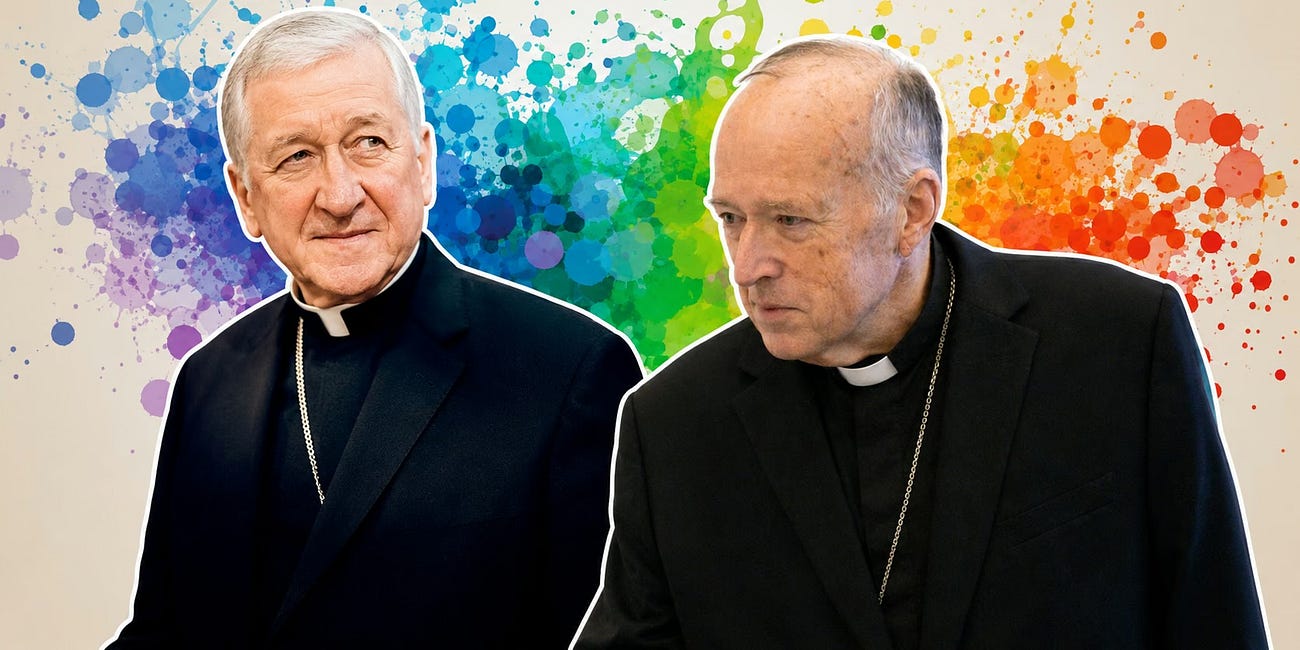
But the rainbow conference got a cardinal letter
And a “Holy Spirit” stamp too
Todos, todos, todos
Everybody come on in
Except the folks with old missals
That’s apparently the sin
Verse 1
Cardinal Bob wrote a love note
Said the Spirit would attend
At a conference full of buzzwords
Where the doctrine likes to bend
Cupich sent a greeting card
With a Chicago velvet smile
“Walking side by side,” he said
For about five synodal miles
They got badges, they got lanyards
They got panels on the floor
They got “lived experience”
Beating doctrine two to four
Then Grandma brings her rosary
And whispers “Kyrie eleison”
Rome jumps out the bushes yelling
“Call Fernández, seize the reason!”
Chorus
Will you help me find my schism?
I think Rome left it on the floor
They searched the Latin chapel
Then blessed Georgetown next door
Will you help me find my schism?
They said it’s somewhere in the pew
But the rainbow conference got a cardinal letter
And a “Holy Spirit” stamp too
Todos, todos, todos
Everybody come on in
Except the folks with old missils
That’s apparently the sin
Verse 2
Study Group Nine came rolling in
With a binder full of haze
Said doctrine’s pre-packaged now
And experience gets a raise
They put sin in the suggestion box
They put Scripture on a slide
They put “journey” in the driver’s seat
And let the commandments ride
At Georgetown, they say “listen”
At Écône, they say “halt”
At Outreach, it’s the Spirit
At the old Mass, it’s assault
They can nuance every rainbow
Till the catechism faints
But a priest says “Introibo”
And they’re rounding up the saints
Chorus
Will you help me find my schism?
I think Rome left it on the floor
They searched the Latin chapel
Then blessed Georgetown next door
Will you help me find my schism?
They said it’s somewhere in the pew
But the rainbow conference got a cardinal letter
And a “Holy Spirit” stamp too
Todos, todos, todos
Everybody gets a chair
Unless you chant the Credo
Then security’s over there
Verse 3
Argentina thanked the courage
Of the lady with the scarf
Green as springtime, red as warning
Somehow bishops missed that part
They remembered all the slogans
They remembered all the pain
They forgot the little babies
And the blood behind the campaign
They can spot a schismatic
At three hundred yards in lace
But abortion’s just a footnote
When it wears a left-wing face
Give a speech on human rights
Get the incense and applause
Ask for the old religion
And they hit you with the laws
Chorus
Will you help me find my schism?
I think Rome left it on the floor
They searched the Latin chapel
Then blessed Georgetown next door
Will you help me find my schism?
They said it’s somewhere in the pew
But the rainbow conference got a cardinal letter
And a “Holy Spirit” stamp too
Todos, todos, todos
Hear the happy slogan ring
Everybody means everybody
Minus those before the spring
Bridge
They got mercy for the movement
They got mercy for the trend
They got mercy for the bishop
Who can’t tell where morals end
They got process for the Germans
They got smiles for every fight
They got dialogue for everyone
Who attacks the Church from left to right
But a chapel full of families
With a missal and a bell
Gets a Roman SWAT team memo
Saying, “See you folks in hell”
They kicked down the chapel door
Looking for rebellion
Found three altar boys, a potluck
And a dad in a Suburban
They said, “Where’s the danger hiding?”
I said, “Maybe down the street
Where the cardinals wrote endorsements
For the sexual retreat”
Final Chorus
Will you help me find my schism?
I think Rome left it on the floor
They searched the Latin chapel
Then blessed Georgetown next door
Will you help me find my schism?
They said it’s somewhere in the pew
But the rainbow conference got a cardinal letter
And a “Holy Spirit” stamp too
Todos, todos, todos
Let the slogan do its dance
If you’re anything but trad
You get a fifty-second chance
Outro
So please repair the chapel door
You broke it hunting ghosts
The schism wasn’t hiding there
It’s wearing Roman posts
You found a missal and a mantilla
You found donuts after Mass
You found kids who know the Sanctus
And a dad low on gas
Meanwhile down at Georgetown
They got bishops on the bill
Saying “Come on, Holy Spirit”
While the doctrine sits still
Will you help me find my schism?
Maybe check the VIP room
Where the fog machine is running
And the synod flowers bloom.
Read the article that inspired it here:
Wednesday, June 3, 2026
What is "Post-conciliar"? Is it Dangerous or Benign?

The professional avant-gardists in the Church today never tire of telling us of the Christian faith in the post-conciliar epoch—of the changes called for by the “post-conciliar spirit.” These vague slogans conceal a tendency to replace the infallible magisterium and unchanging faith of the Church with something else, something new. I am reminded of the famous program of the German National Socialist Party, which in paragraph 17 declared that it accepted Christianity insofar as it corresponded to the “Nordic ethos.” In that case too the divinely revealed doctrine of the Church was supposed to subordinate itself to an extremely vague and, moreover, purely natural norm.
 |
| John Henry Cardinal Newman |
But, of course, any contradiction in defined dogma is incompatible with the infallible magisterium of the Church. Any implication, therefore, that Vatican II has in any way abrogated dogmatic expositions of former councils calls into question the divine institution and perpetual guarantee of the Catholic faith. Furthermore, the Second Vatican Council made no dogmatic definitions: Its purpose was strictly pastoral in nature. And Vatican II declared expressis verbisthe continuity of the “spirit” of its utterances with that of former councils. The Holy Father gave a clear answer to those who wish to treat Vatican II as a kind of beginning of the authentic Christian revelation, as a new norm against which the teachings of former Councils must be measured: “The teachings of the Council do not constitute a complete, organic system of Catholic doctrine. Doctrine is much more extensive, as everyone knows, and it is not called into question by the Council nor substantively modified” (Address of Pope Paul VI, Jan. 12, 1966).
But in reality the propagators of the “post-conciliar spirit” do not truly identify it with the spirit of the decrees of Vatican II. The term itself—”post-conciliar spirit,” “post-conciliar Church”—clearly suggests that something quite different is meant. Often this is openly and frankly admitted as at the [1967] Toronto Congress, where the Vatican Council was seen by some speakers as only a beginning but as not fully expressing the “post-conciliar spirit.” In fact, this conveniently vague notion has no basis in the infallible magisterium of the Church. It represents, rather, a mentality nourished by historical relativism and at the service of that fictional creature “modern man.”
Yet, the “post-conciliar spirit” cannot justly designate the state of the Church after Vatican II, for no one can deny that there are contradictory currents within the framework of the Church today, not one trend that embraces all Catholics. Thus, it is not even possible to speak of a “post-conciliar spirit” that is analogous to the “post-Tridentine mentality.” The Council of Trent imposed through its precise and emphatic definitions of faith a lucid unity of spirit on the hierarchy, clergy, and all the faithful, a spirit that stamped the time which we know today as the Counter-Reformation.
If we wish to know precisely in what the new modernism that calls itself the “post-conciliar spirit” consists, we have only to turn to the numerous warnings of the Holy Father. If we examine the speeches and writings of the heralds of the “post-conciliar spirit,” we shall find that the real content of this spirit is the desire to conform to “modern times,” “the scientific age,” to “man come of age.” (Of course, the new norm is as much a mere speciality of a single epoch as the National Socialist “ethos of the Nordic race” was a specialty of a single people.)
This modernization of the Church is put forward as an attempt to deepen the truth of Christian revelation, to free the deposit of Catholic faith of “mythological elements.” But in making the alleged mentality of our epoch the criterion of the faith, these post-conciliar spirits are only replacing the perennial faith with short-lived and often self-contradictory slogans. The fashionable theories that fill the air are usually no more than sophisticated superstitions. In choosing these as the norm for their alleged deepening of the Christian truth, the post-conciliarites have, in reality, set the wolf to mind the sheep.
Perhaps the most pervasive manifestation of the “post-conciliar spirit” is the unrestricted freedom many assume in the discussion of religious matters, a penchant for re-examining the dogmas, instead of accepting the deposit of Catholic faith as transmitted infallibly by the Church. But when these post-conciliar persons assert that the Church must be adapted to the mentality of our epoch, they had in mind meeting all the objections that are made against the Church—notionly by the Protestant denominations but also by the “world.” The deepest desire of some of our progressives seems to be to measure up in the eyes of the world. But this attitude in no way grows out of a genuine thirst for truth, but comes, rather, from an unwarranted respect for the opinions of the world and from fear of the world’s censure; it comes from having chosen to replace the infallible magisterium of the Church with certain contemporary opinions.
The absurdity of all these perversions of the faith is most flagrant in those who assert that they are deepening the truth, after first having proclaimed that there is no “static truth.” This self-contradictory position, born out of radical historical relativism, would (if it were possible to take it seriously) make all striving for truth senseless, the appeal to truth an empty gesture, and faith and religion utterly meaningless.
Of course, the unchangeable character of the Church is a scandal to the world and the worldly. But the Catholic should rather affirm this unchangeableness as a sign of her supernatural foundation: “Lo! The fair form of the ancient Church rises up at once, as fresh and vigorous as if she had never intermitted her growth. She is the same as she was three centuries ago, ere the present religions of the country existed, you know her to be the same; it is the charge brought against her that she does not change; time and place affect her not, because she has her source where there is neither place nor time, because she comes from the throne of the Illimitable Eternal God”
(John Henry Cardinal Newman, “Prospects of the Catholic Missioner” in Discourses to Mixed Congregations).
Subscribe to:
Posts (Atom)