Showing posts with label Pope Leo XIV. Show all posts

Thursday, July 2, 2026

The Dogma of Extreme - SSPX vs Leo XIV's Vatican

15,000 people gathered in Écône, Switzerland, for the SSPX Ordination
of four new bishops. The size of the crowd is evidence.


In her "Forward Boldly" podcast, Christine Niles recently proclaimed that the SSPX's claim that the Novus Ordo (NO) Mass is "evil" was "extreme," and therefore, because it was "extreme," SSPX was wrong. Christine went on to explain SSPX's rationale for their "evil" claim. The claim centered on sins of omission, not commission. SSPX does not like the NO Mass because of what it leaves out of the TLM (Tridentine Mass). I agree with SSPX on this. But I had not thought of the sin of ignoring what was previously considered sacred and necessary as evil. SSPX points to a slippery slope. What do we eliminate next?  For hundreds of years, and I believe numerous popes, have proclaimed the TLM as sacred and necessary. Now Francis and Leo think it's wrong and should not be celebrated. To me that is extreme. 

I came into the church from Protestant Evangelicalism in 1998. One reason was that I could understand the NO, which was celebrated in my English vernacular. But since then, in my Catholic apologetic work and research, I have come to believe that the NO is a rebellion against the reverence of the traditional TLM, and that, by eliminating prayers and acts of reverence and by modern accommodation, it has become sacramentally vulgar...and therefore I have no problem with the SSPX's claim that it is evil. 

The NO is priest-centered, not God-centered; it does not respect the Eucharist liturgically (in 100 ways), and by the use of extraordinary ministers, and promoting communion in the hand. The NO is "versus populum" (facing the people) with the priest turning his back to God. This is the explicit expression of the logical fallacy "ad populum" (making accommodation to the people and the masses). Although I’m told "ad orientem" (the priest and people face God)  is not strictly forbidden in the NO, our “wonderful” new “Francis” bishop here in Detroit (Wiesenberger) has forbidden it. Some bishops are refusing to let us kneel to receive the body of our Lord. THESE are the EXTREMES. Christine Niles gets it wrong.

The claim of extremes should be directed to the NO and Francis and Leo’s objection to the TLM. But there are more extremes in the NO.

The use of the vernacular is not conducive to worship of God Almighty, when we have a liturgical language (Latin) that is not used anywhere in the secular world. The virtue of Latin is that,  unlike vernacular languages, Latin does not change. It's a "dead" language. Vernacular languages contribute to misunderstandings through linguistic and logical fallacies and thus are crucibles for heresies. I've said for years that Protestantism is the consequence of equivocations (misuse of the vernacular).

Compared to chant, the use of popular music is like fingernails on a chalkboard. 

I'll say nothing about how people dress and act in the NO vs the TLM. (Well, I guess I did say something.) Yes, the NO could be more reverent, but the tone of Vatican II (V2) and how it has been implemented in the NO promote shorts and flip-flops, indifference to the Eucharist and all things formerly held sacred. 

Vatican II, from which the NO evolved, is pastoral, not dogmatic or doctrinal.  No new doctrines were defined, nor was a heresy condemned. And yet, Francis and Leo and many bishops act as if V2 is dogmatic, and therefore treat the NO as dogma. But NOTHING out of V2 is dogmatic, so why are we pretending the secular, modernist NO is dogmatic? 

(see https://www.youtube.com/c/MassoftheAges)

I am disturbed by pundits incorrectly calling everything a pope does as "indefectible," which means the pope is unfailing, faultless, and incapable of defect or decay. Traditionis Custodes is not an ex cathedra infallible pronouncement. It was Francis's opinion, no doubt driven by wrongheaded (evil?) influences in the Vatican or his own ignorance of the TLM since he wasn't ordained until after V2 and may have never celebrated or even sat through a TLM. 

Consider this. Historically, Popes have issued documents (papal bulls) whereby slavery was authorized as acceptable. [c.f. Nicholas V's Dum Diversas (1452), Nicholas V's Romanus Pontifex (1455), and Alexander VI's Inter Caetera (1492).] Stop with the indefectibility heresy. Popes are sinners like the rest of us.  Stop conflating "indefectibility" with infallibility, wherein what has been rare (infallibility) becomes ubiquitous (indefectibility). Yes, you will try to parse the words. But it’s not convincing. Shall we start to enumerate past popes' foibles and sins to make the point? (c.f. the children of Alexander VI, Paul III, and Julius II)  Traditionis Custodes will soon be recanted as wrong.

Finally, Cardinal Victor Manuel Fernandez, who has been charged with writing much for Francis (and Leo?), is a disgrace, starting with his authorship as a priest of "Heal Me With Your Mouth: The Art of Kissing." Fernandez's writing of Laudato si is unreadable by anyone with a science background. I’ve tried three times, and my degree in physics makes the document a textbook example of cringe. Fernandez also authored Fiducia Supplicans, which has popularly been interpreted as approval of blessing homosexual unions, though Francis has backtracked that interpretation...and yet Fr. James Martin has done it with immunity. 

So, the Vatican is not always a credible source of what is right and wrong. As expected of any human institution, the Vatican, at times (and currently, I claim), bastardizes Jesus' prophecy that the Church would get everything right. I suppose the prophecy that the Church would fall in the last days is coming true. 

Critical thinking (comparing and contrasting) with history and truth sustained through the centuries is necessary. Do it. Use it. 

Wednesday, June 24, 2026

One Non-Intellectual but Pious Experience with SSPX

As I reflect on the current controversy in the Catholic Church regarding the Latin Mass and SSPX, I recall that the church building in Rocky River, OH, which was my grandfather's church (Rev. Jeremiah Williams, a Free Methodist pastor and circuit riding preacher on horseback) was most recently a SSPX chapel. 

This lady is not an intellectual, but she has a pious, fresh, and knowledgeable perspective.


Saturday, June 20, 2026

Will You Help Me Find My Schism?


Intro
Yeah
They kicked in the chapel door
Looking for schism
Found a veil, a missal
And six kids eating donuts
Uh oh

Chorus
Will you help me find my schism?
I think Rome left it on the floor
They searched the Latin chapel
Then blessed Georgetown next door

Will you help me find my schism?
They said it’s somewhere in the pew
But the rainbow conference got a cardinal letter
And a “Holy Spirit” stamp too

Todos, todos, todos
Everybody come on in
Except the folks with old missals
That’s apparently the sin

Verse 1
Cardinal Bob wrote a love note
Said the Spirit would attend
At a conference full of buzzwords
Where the doctrine likes to bend

Cupich sent a greeting card
With a Chicago velvet smile
“Walking side by side,” he said
For about five synodal miles

They got badges, they got lanyards
They got panels on the floor
They got “lived experience”
Beating doctrine two to four

Then Grandma brings her rosary
And whispers “Kyrie eleison”
Rome jumps out the bushes yelling
“Call Fernández, seize the reason!”

Chorus
Will you help me find my schism?
I think Rome left it on the floor
They searched the Latin chapel
Then blessed Georgetown next door

Will you help me find my schism?
They said it’s somewhere in the pew
But the rainbow conference got a cardinal letter
And a “Holy Spirit” stamp too

Todos, todos, todos
Everybody come on in
Except the folks with old missils
That’s apparently the sin

Verse 2
Study Group Nine came rolling in
With a binder full of haze
Said doctrine’s pre-packaged now
And experience gets a raise

They put sin in the suggestion box
They put Scripture on a slide
They put “journey” in the driver’s seat
And let the commandments ride

At Georgetown, they say “listen”
At Écône, they say “halt”
At Outreach, it’s the Spirit
At the old Mass, it’s assault

They can nuance every rainbow
Till the catechism faints
But a priest says “Introibo”
And they’re rounding up the saints

Chorus
Will you help me find my schism?
I think Rome left it on the floor
They searched the Latin chapel
Then blessed Georgetown next door

Will you help me find my schism?
They said it’s somewhere in the pew
But the rainbow conference got a cardinal letter
And a “Holy Spirit” stamp too

Todos, todos, todos
Everybody gets a chair
Unless you chant the Credo
Then security’s over there

Verse 3
Argentina thanked the courage
Of the lady with the scarf
Green as springtime, red as warning
Somehow bishops missed that part

They remembered all the slogans
They remembered all the pain
They forgot the little babies
And the blood behind the campaign

They can spot a schismatic
At three hundred yards in lace
But abortion’s just a footnote
When it wears a left-wing face

Give a speech on human rights
Get the incense and applause
Ask for the old religion
And they hit you with the laws

Chorus
Will you help me find my schism?
I think Rome left it on the floor
They searched the Latin chapel
Then blessed Georgetown next door

Will you help me find my schism?
They said it’s somewhere in the pew
But the rainbow conference got a cardinal letter
And a “Holy Spirit” stamp too

Todos, todos, todos
Hear the happy slogan ring
Everybody means everybody
Minus those before the spring

Bridge
They got mercy for the movement
They got mercy for the trend
They got mercy for the bishop
Who can’t tell where morals end

They got process for the Germans
They got smiles for every fight
They got dialogue for everyone
Who attacks the Church from left to right

But a chapel full of families
With a missal and a bell
Gets a Roman SWAT team memo
Saying, “See you folks in hell”

They kicked down the chapel door
Looking for rebellion
Found three altar boys, a potluck
And a dad in a Suburban

They said, “Where’s the danger hiding?”
I said, “Maybe down the street
Where the cardinals wrote endorsements
For the sexual retreat”

Final Chorus
Will you help me find my schism?
I think Rome left it on the floor
They searched the Latin chapel
Then blessed Georgetown next door

Will you help me find my schism?
They said it’s somewhere in the pew
But the rainbow conference got a cardinal letter
And a “Holy Spirit” stamp too

Todos, todos, todos
Let the slogan do its dance
If you’re anything but trad
You get a fifty-second chance

Outro
So please repair the chapel door
You broke it hunting ghosts
The schism wasn’t hiding there
It’s wearing Roman posts

You found a missal and a mantilla
You found donuts after Mass
You found kids who know the Sanctus
And a dad low on gas

Meanwhile down at Georgetown
They got bishops on the bill
Saying “Come on, Holy Spirit”
While the doctrine sits still

Will you help me find my schism?
Maybe check the VIP room
Where the fog machine is running
And the synod flowers bloom.

Read the article that inspired it here:

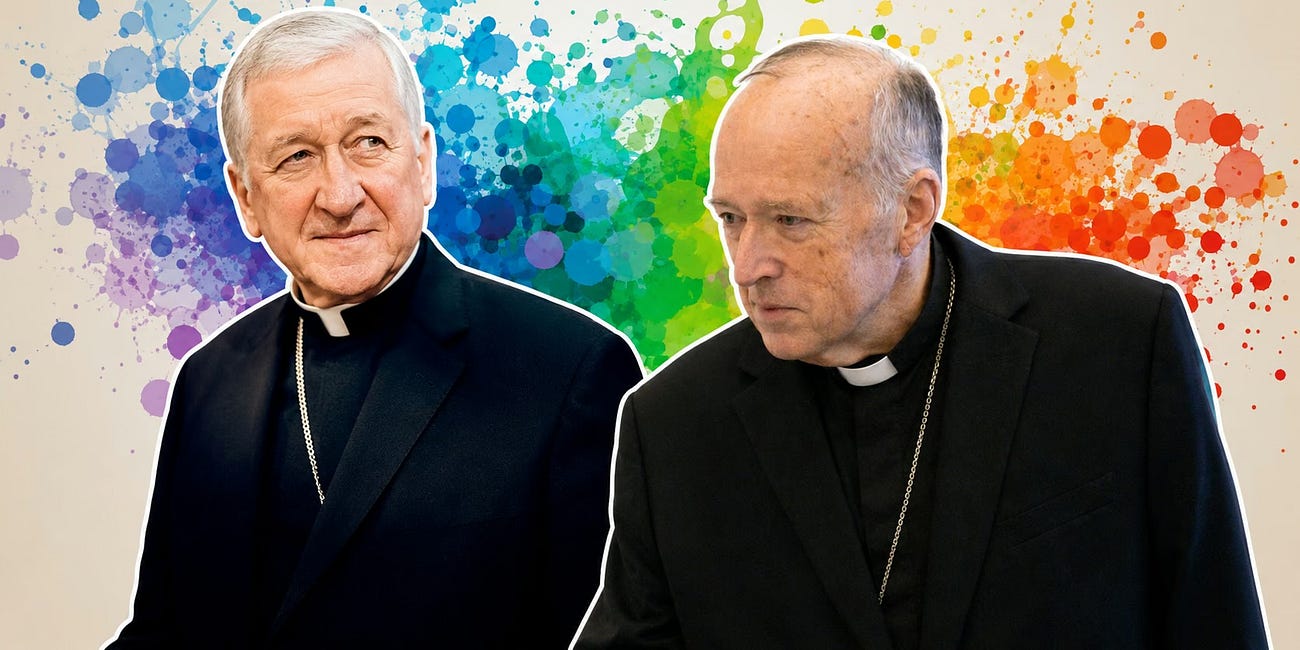
McElroy Says Leo Deepens Francis’ LGBT Project While Rome Looks to Excommunicate Every SSPX Priest

·
9:35 AM
McElroy Says Leo Deepens Francis’ LGBT Project While Rome Looks to Excommunicate Every SSPX Priest

McElroy Welcomes Outreach to Washington

Read full story

Wednesday, June 3, 2026

What is "Post-conciliar"? Is it Dangerous or Benign?

I copied this short essay from Catholic.com. It is cited (at the end) as written by John Henry Cardinal Newman,  from his document: “Prospects of the Catholic Missioner” in Discourses to Mixed Congregations. I am not well-read on this topic, but the term "post-conciliar framework" was used in an essay by Chris Jackson to reference to Pope Leo XIV's recent appointment of a laywoman (Maria Montserrat Alvarado) as Prefect of the Vatican Dicastery for Communication, a position historically held by a male priest. Leo XIV worries me, as did Francis. This essay explains why.

The professional avant-gardists in the Church today never tire of telling us of the Christian faith in the post-conciliar epoch—of the changes called for by the “post-conciliar spirit.” These vague slogans conceal a tendency to replace the infallible magisterium and unchanging faith of the Church with something else, something new. I am reminded of the famous program of the German National Socialist Party, which in paragraph 17 declared that it accepted Christianity insofar as it corresponded to the “Nordic ethos.” In that case too the divinely revealed doctrine of the Church was supposed to subordinate itself to an extremely vague and, moreover, purely natural norm. 

John Henry Cardinal Newman
But does not the expression “post-conciliar spirit” refer to the “spirit of Vatican II”? And is it not, therefore, something precise and Christian? But even if this were the intended meaning, the effect would be to represent the Second Vatican Council (the “spirit” of its decrees) as an ultimate norm that is played off against the former Councils—above all, against the Council of Trent. Now, the moment one implies that one council has rendered others outmoded, irrelevant, the question immediately arises: Whence does one derive the conviction that the truth of the Holy Spirit is to be found more in this council than in others? In the first place, even if a council could err in its dogmatic definitions, there is no reason to suppose that the latest council is less exposed to error than former ones. 

But, of course, any contradiction in defined dogma is incompatible with the infallible magisterium of the Church. Any implication, therefore, that Vatican II has in any way abrogated dogmatic expositions of former councils calls into question the divine institution and perpetual guarantee of the Catholic faith. Furthermore, the Second Vatican Council made no dogmatic definitions: Its purpose was strictly pastoral in nature. And Vatican II declared expressis verbisthe continuity of the “spirit” of its utterances with that of former councils. The Holy Father gave a clear answer to those who wish to treat Vatican II as a kind of beginning of the authentic Christian revelation, as a new norm against which the teachings of former Councils must be measured: “The teachings of the Council do not constitute a complete, organic system of Catholic doctrine. Doctrine is much more extensive, as everyone knows, and it is not called into question by the Council nor substantively modified” (Address of Pope Paul VI, Jan. 12, 1966). 

But in reality the propagators of the “post-conciliar spirit” do not truly identify it with the spirit of the decrees of Vatican II. The term itself—”post-conciliar spirit,” “post-conciliar Church”—clearly suggests that something quite different is meant. Often this is openly and frankly admitted as at the [1967] Toronto Congress, where the Vatican Council was seen by some speakers as only a beginning but as not fully expressing the “post-conciliar spirit.” In fact, this conveniently vague notion has no basis in the infallible magisterium of the Church. It represents, rather, a mentality nourished by historical relativism and at the service of that fictional creature “modern man.” 

Yet, the “post-conciliar spirit” cannot justly designate the state of the Church after Vatican II, for no one can deny that there are contradictory currents within the framework of the Church today, not one trend that embraces all Catholics. Thus, it is not even possible to speak of a “post-conciliar spirit” that is analogous to the “post-Tridentine mentality.” The Council of Trent imposed through its precise and emphatic definitions of faith a lucid unity of spirit on the hierarchy, clergy, and all the faithful, a spirit that stamped the time which we know today as the Counter-Reformation. 

If we wish to know precisely in what the new modernism that calls itself the “post-conciliar spirit” consists, we have only to turn to the numerous warnings of the Holy Father. If we examine the speeches and writings of the heralds of the “post-conciliar spirit,” we shall find that the real content of this spirit is the desire to conform to “modern times,” “the scientific age,” to “man come of age.” (Of course, the new norm is as much a mere speciality of a single epoch as the National Socialist “ethos of the Nordic race” was a specialty of a single people.) 

This modernization of the Church is put forward as an attempt to deepen the truth of Christian revelation, to free the deposit of Catholic faith of “mythological elements.” But in making the alleged mentality of our epoch the criterion of the faith, these post-conciliar spirits are only replacing the perennial faith with short-lived and often self-contradictory slogans. The fashionable theories that fill the air are usually no more than sophisticated superstitions. In choosing these as the norm for their alleged deepening of the Christian truth, the post-conciliarites have, in reality, set the wolf to mind the sheep. 

Perhaps the most pervasive manifestation of the “post-conciliar spirit” is the unrestricted freedom many assume in the discussion of religious matters, a penchant for re-examining the dogmas, instead of accepting the deposit of Catholic faith as transmitted infallibly by the Church. But when these post-conciliar persons assert that the Church must be adapted to the mentality of our epoch, they had in mind meeting all the objections that are made against the Church—notionly by the Protestant denominations but also by the “world.” The deepest desire of some of our progressives seems to be to measure up in the eyes of the world. But this attitude in no way grows out of a genuine thirst for truth, but comes, rather, from an unwarranted respect for the opinions of the world and from fear of the world’s censure; it comes from having chosen to replace the infallible magisterium of the Church with certain contemporary opinions. 

The absurdity of all these perversions of the faith is most flagrant in those who assert that they are deepening the truth, after first having proclaimed that there is no “static truth.” This self-contradictory position, born out of radical historical relativism, would (if it were possible to take it seriously) make all striving for truth senseless, the appeal to truth an empty gesture, and faith and religion utterly meaningless. 

Of course, the unchangeable character of the Church is a scandal to the world and the worldly. But the Catholic should rather affirm this unchangeableness as a sign of her supernatural foundation: “Lo! The fair form of the ancient Church rises up at once, as fresh and vigorous as if she had never intermitted her growth. She is the same as she was three centuries ago, ere the present religions of the country existed, you know her to be the same; it is the charge brought against her that she does not change; time and place affect her not, because she has her source where there is neither place nor time, because she comes from the throne of the Illimitable Eternal God” 

(John Henry Cardinal Newman, “Prospects of the Catholic Missioner” in Discourses to Mixed Congregations).