Info at: https://wizardclip.stanwilliams.com

Showing posts with label The Wizard Clip Haunting. Show all posts
Showing posts with label The Wizard Clip Haunting. Show all posts
Wednesday, June 24, 2026

Thursday, May 28, 2026
SPACED OUT RADIO Interview with Dave Scott
Last night, I was the guest on Dave Scott's "Spaced Out Radio," a live terrestrial radio program out of British Columbia, Canada that is heard on 8 stations around the U.S., and later posted on YouTube.
The impetus was the new trilogy edition of my historical novel, Wizard Clip Haunting, and its paranormal storyline. We had a great time and talked for 2 hours (with station and commercial breaks) about the juxtaposition of the natural and supernatural, the paranormal and the normal.
Dave has an avid nightly following talking about American and Canadian Ghost Stories, Paranormal True Encounters, Real History, UFOs, and Big Foot. He's located in the wilderness between the Cascade Mountains and the North Rocky Mountains (God's country).
Below is the YouTube version of the podcast, complete with off-air chatter and the silence during terrestrial radio station breaks.
Related to this is my Nineveh's Crossing blog post "Is Christianity Paranormal" which contains links to posts on the same subject from Amanda Arrows, and Fr. Dwight Longenecker.
Monday, November 20, 2023
Thank you, Loretto and St. Francis University
 |
| The Water Bill Flyer |
I returned from my first Wizard Clip Haunting book tour a month ago, and since then I've been hunkered down preparing and marketing the History of the Catholic Faith in the America's Conference (Saturday, December 19, 2023 at the Priest Field Pastoral Center in Middleway, WV).
One of my desired tour stops was the Allegheny mountain village of Loretto, PA, the town founded by Fr. Demetrius Augustine Gallitzin. For reasons covered elsewhere, it was Gallitzin who became the natural choice to narrate Wizard Clip Haunting.
I did speak in Loretto and I have a number of people to thank for that very rewarding evening.
To get an invite to Loretto to speak, I first contacted Fr. John Byrnes, the priest at the parish Gallitzin founded, St. Michael's Basilica. But the church hall and Gallitzin's historic chapel house were both under renovation. Fr. Byrnes (pronounced Burns) suggested I call the president of St. Francis University (SFU), Fr. Malachi Van Tassell. Fr. Malachi was very receptive to the idea and put me in touch with the Dean of the school's STEAM program, Dr. Peter Skoner. (It's not STEM, but STEAM. The A stands in for Arts and Humanities, thus SFU is a true liberal arts university.)
In turn, Dr. Skoner turned me over to the chair of the history department, Dr. Denise Damico, who was enthusiastic about my visit. We set a date and time, they provided a cottage on campus to stay in and meals for Pam and I, and then Samantha Gorman, Skoner's assistant, ordered eight copies of the novel...no doubt to give the faculty time to read the novel before I got there...just in case they wanted to head-me-off at the Allegheny Mountain pass.
 |
| Stan at Fr. Gallitzin's desk, at which (Chapter 1) Fr. Gallitzin narrates Stan's novel. |
After spending a few hours visiting classrooms, I gave an evening lecture. The turn out was the largest of the tour. About 100 town and university folks including a few students showed up. Not a few brought the novel they had purchased from Amazon and asked me to sign their copies. And, we started to sell books as soon as people arrived, even before the talk...first time that's happened. One family brought three Amazon purchased paperbacks (yes 812 pages each) and asked me to sign them. They were well into their books (all at once) and most impressive to me was their 10-year old daughter who was around page 300 and loving it. Okay, so she must have been a Catholic homeschooler...by and large such children are ahead of the curve.
 |
| Fr. Gallitzin's crypt guarding St. Michael's Bascilica |
I can't take all the credit for the large turn out. For one thing the flyer is better worded and better looking than any of my ads. Second, it was sent to a captive audience that had to read it or have their water turned off. But, third, Pam and I discovered that there is nothing to do in Loretto at night unless you're a barn owl. There is no restaurant, (not even a McDonalds), no movie theaters, no shopping centers, no band shell, no gas station, no shuffle board court, no golf courses, no traffic light, no newspaper, and no police force. Although they do have a post office, some entertainment that is. Wait! There is an American Legion Hall, although I'm not sure what goes on there. The ONLY thing in town is the University, luckily (err, I mean Providentially) it's beautiful, big, and the food is great at the student union and cafeteria. So, when there's something happening at the University, people turn out. Fourth and finally, my public lecture was on a Monday night when there were no sporting events schedule.
Oh, but I forgot, there is the water bill inserts. They can be interesting.
 |
| The author with Betty Seymour in her beautiful Victorian parlor. |
 |
| St. Francis overlooking the Chapel at St. Francis University |
Monday, October 30, 2023
Harnessing Halloween Horror in Catholic-Themed Novel
Today on Beliefnet.com, John Kennedy reviews my Catholic-theme release, Wizard Clip Haunting: A True Early American Ghost Story
If the link is broken, here's the article:
Author Stanley D. Williamsharnesses Halloween horrorin Catholic-themed"Wizard Clip Haunting"
 True terror? A filmmaker, author, and screenplay consultant, Stan D. Williams is known for his book The Moral Premise: Harnessing Virtue and Vice for Box Office Success defining a clear sense of morality as an essential ingredient in developing stories that will not only be financially successful but will stand the test of time. Should Wizard Clip Haunting, his new novel based on an actual early American ghostly legend be adapted to film, an opening around Halloween would seem appropriate.
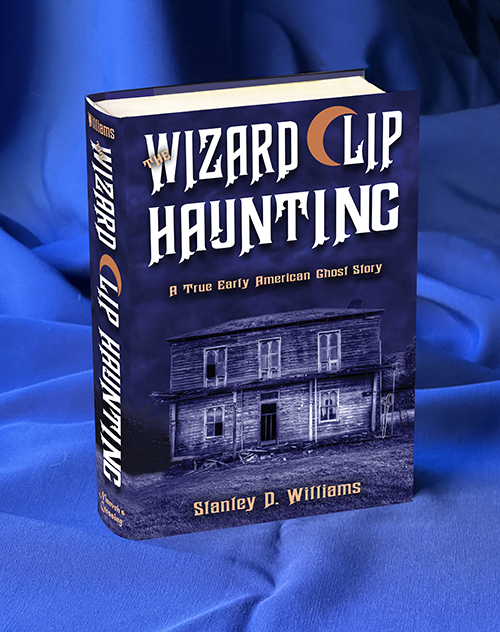
Stanley D. Williams: The Wizard Clip haunted house affair of 1794-1797 in what was then Smithfield, Virginia (today Middleway, West Virginia) is cited as the best documented ghost story in American history. A simple Internet search will reveal hundreds of references, many reaching back to the 1800s.
My novel, Wizard Clip Haunting, is a historical fiction novel that attempts to weave together the many well-documented and disturbing events and exorcism into a cogent, entertaining and informative tale.
The novel chronicles the historic, tragic and adventurous lives of four characters. The first is the focus of our story, Adam Livingston, an innovative Pennsylvania flax farmer vexed from early childhood with vague premonitions of tragedies. Adam’s first wife, Esther, was a devout Presbyterian who cared for her family and used her talent at the loom to help clothe the poor. She believed their good but meager life was God’s blessing. But, although Adam deeply loved Esther, he was pretty sure any success they had was due to his hard work.
Suddenly, during the harvest, Esther mysteriously dies and Adam loses their small farm. Thereafter, he and his two children migrate to the Shenandoah Valley in Virginia where he acquires a much larger farm with great potential – but tragedy strikes when he rebukes Virginia’s culture of slavery. A couple years later, when Adam remarries, he takes revenge on God for Esther’s death and marries a woman who hates all religion; the results are unwelcomed and tragic.
Woven into Livingston’s story is that of Denis Cahill, who dodges death in Ireland, becomes a renegade Capuchin priest, lives through the catastrophic New Orleans Fire of 1788, and after, sails past storms and pirates into the young United States in search of his calling, a destiny he could never have planned.
The third character, who historically has come to be known as the Wizard Clip, or the Clipping Wizard, is an impatient and murderous Babylonian spirit who is tasked with Livingston’s and Cahill’s downfall by edging them closer and closer to the gates of hell.
The fourth character is the cursed plot of land that absorbs the blood of a murder…and serves as the stage for the Wizard’s hauntings. After lying fallow for over a hundred years, the land finally finds redemption as the Priest Field Pastoral Retreat Center in Middleway, West Virginia, which today you can visit.
At the halfway mark in the book, what in Narrative Theory is called the Moment of Grace, a mysterious sojourner lodges at the Livingston’s home and in the middle of the night realizes he’s going to die. He asks his hosts to fetch a Catholic priest to hear his confession and give him last rites – but the Livingstons refuse, having promised themselves, in keeping with the times, that no Catholic priest would ever cross the threshold of their house. Before the stranger dies, he curses the Livingstons, their house and farm.
At the halfway mark in the book, what in Narrative Theory is called the Moment of Grace, a mysterious sojourner lodges at the Livingston’s home and in the middle of the night realizes he’s going to die. He asks his hosts to fetch a Catholic priest to hear his confession and give him last rites – but the Livingstons refuse, having promised themselves, in keeping with the times, that no Catholic priest would ever cross the threshold of their house. Before the stranger dies, he curses the Livingstons, their house and farm.
Immediately, the haunts begin: strange noises, black vapor, wraiths of horses and wagons, china flies off shelves, logs fly from the fire to orbit the gathering room, crops fail, animals die in bizarre ways and most peculiar, the sounds of scissors and the physical clipping of crescent moon shapes from anything made from flax linen.
Adam soon realizes that the noises and the clippings are not practical jokes put upon them by neighbors but by a demon their young daughter Eve calls “The Wizard.” When Adam finally decides to fight fire-with-fire, he recruits a variety of ministers to come to the house and exorcise it – but all fail and the farm becomes the curiosity of the region with folks just dropping by with both tragic and comedic results. The haunts escalate, especially when a minister shows up…and when a Catholic priest appears all hell breaks loose. For reasons they don’t fully understand, the Livingstons and friends are catapulted along to a final and cataclysmic conclusion.
JWK: What drew you to this story?
SDW: I’m a professional story consultant and filmmaker. Since 2006 when my Hollywood story-structure book (The Moral Premise) was released, I’ve worked for writers and producers in the film industry – and a few novelists – helping their stories connect with audiences. On the side, I also produce and distribute Catholic apologetic media. In 2012 a Filipino man living in Australia, knowing my work, called me and pitched the Wizard Clip story to me as a film idea. I didn’t have the money to make the movie, so I wrote a screenplay. It got some interest in Los Angeles but no funding for the movie.
In 2014 I got curious about one of the character’s disposition after the exorcism, Fr. Denis Cahill. Research trips to New Orleans, Pittsburgh, West Virginia and Maryland convinced me that the story was not a movie but a novel, a long one. It had all the elements of a major Hollywood movie but it was deeply imbedded in American history and involved a number of historical characters from America’s founding. It was just too interesting to pass up.
JWK: Do you believe the haunting was real?
SDW: I completely believe the hauntings were real for a number of well-documented reasons. Middleway, West Virginia today still celebrates the hauntings with badges on the front of the homes that existed at the time depicting the disturbances. The badges depict a pair of scissors, a crescent moon and a magician in a top hat that stands in for the clipping demon. The town is nicknamed “Clip.” There are thirty-some versions of the story from various perspectives with basically the same record of events; some are eye-witnesses.
Four Catholic priests investigated the events, including America’s first bishop, Rev. John Carroll…All the priests were initially skeptical. Fr. Demetrius Augustine Gallitzin was sent by Carroll to investigate. Gallitzin later wrote “After three months of investigation, I was soon converted to a full belief of them. No lawyer in a court of justice did more than I, nor procured more than your unworthy servant.”
And then there’s a existence today of Priest Field Pastoral Retreat Center which sits on the 35 acres of land given to the local Catholic society by the former agnostic Adam Livingston in appreciation for what Fr. Denis Cahill and Fr. Gallitzin did in ridding his property of the demon.
JWK: What’s the message you hope readers take from the story?
SDW: The main message behind the true story of the events is the authority of natural law in human relationships. Based on my book The Moral Premise, all success stories must deal with a conflict of values – a vice versus an opposing virtue – that is true to natural law principles. Thus, every character in Wizard Clip Haunting is challenged to acknowledge and live by the authority of Natural Law. Some do, some don’t. Natural consequences follow.
The story also underscores the validity of the Catholic priesthood, the Mass and the Sacraments – even when priests are not in a perfect state of grace.
Lastly, and perhaps most obviously, the original story and the novel underscore the reality of the demonic world with cautions to take evil seriously and project one’s life with truth.
JWK: Do you see a movie here?
SDW: The story came to me originally as a movie and I wrote a screenplay – but as the Hollywood adage goes: “Write the book first…and sell a million copies.” I would love to see a movie made.
JWK: Any ideas for casting or who you’d like to see direct?
SDW: I have not thought of casting. By the time this might get made potential actors would be too old and new actors would be on the market. I would direct, of course. LOL!
Friday, June 30, 2023
My Motivations for Writing "The Wizard Clip Haunting" Novel

In preparing remarks for book talks that I plan to give in the coming months, you may find this segment (5. Motivations) of historical interest. It is the principle reason for my ten-year effort to finish the novel. Your comments are most welcome. (Stan Williams)
5. Motivations
My writing of The Wizard Clip Haunting was significantly motivated by what is generally unknown about the persecution of Catholics in England, Ireland, and how that persecution came to the British Colonies and became imbued into the culture of the United States. Let me review the history of the British contribution to the Protestant Reformation that has so imbued American culture to this day. A great deal of what I’m going to share is reflected in the novel as the prime motivation, not just for me the writer, but as the deep seated motivation for many of the Wizard Clip characters. My hope is that the novel will shed light on the origins of our culture and encourage us to avoid the prejudices of the past.
I grew up being taught that America was established as a safe haven for religiously persecuted Europeans; particularly which religious sects were being persecuted and by whom I was unsure. I did know that the Pilgrims and Puritans, for some reason, were at odds with The Church of England, but I didn’t know much more than that.
As a teenager in the 1960s in the Midwest, I recognized a strong bias against Catholics who lived in our suburban neighborhood. I didn’t understand this completely, except for what my mother inferred...that the Catholics were idolaters, not Christian. That my school chum next door was Catholic had something to do with it, in so far as he took after his Dad who drank a lot of beer, smoked packs of cigarettes, and swore a lot. It didn’t take much to persuade me that my mother was right.
Penal Laws - UK & Ireland
But it wasn’t until my college years that I became aware of the 17th and 18th century British penal laws, which outlawed all things Catholic, even to the point of imprisoning citizens, confiscating their land and possessions, animals, heritage rights, and executing priests who refused to be exiled. The penal laws also made celebrating the Catholic Mass and transubstantiation illegal. Other laws barred Catholics from voting, holding office, owning land, bringing religious items from Rome into Britain, and prohibited the publishing or selling of Catholic materials.
I had no idea about any of this. It surprised me. More research was clearly necessary.
The source of the penal laws was Henry VIII and his political and moral battle with the Vatican when Pope Clement VII refused to annul his marriage with Catherine of Aragon because, due to miscarriages and still births, she had not given him a male heir but only one daughter, Mary. In 1529 Henry banished Catherine from court, and persuaded his political fixers to arrange his marriage to Anne Boleyn, which they did.
The next year, in 1530, Henry took revenge on the Vatican. He convinced parliament to start work on a series of laws that would come to be known as the penal laws. Over the coming years they:
- Established Britain’s break from Catholicism
- Confiscated all Catholic property, land, monasteries, convents, and possessions
- Made Henry the head of the newly formed Church of England
- Outlawed Catholicism in English life, and
- Transferred significant wealth from the Catholic Church to the English Crown.
- After that, it was only natural for Pope Clement VII to excommunicate Henry, or we might say, Henry VIII excommunicated himself.
The penal laws were refined and expanded over the years, and eventually implemented in Ireland, which dramatically affected the life of several main characters in the novel. There were, however, attempts to mitigate the laws during the reigns of Catholic monarchs Mary Tudor (1553–1558) and James II (1685–1688).
In the early 17th century, certain British Catholics, although persecuted, were not idle. During the reign of Protestant James I, a group of Catholics tried to assassinate the king and the House of Lords in what is known as the Gunpowder Plot. On 5th of November 1605 the plot was foiled and several of the Catholic rebels were executed including the man guarding the explosives in the undercroft of the House of Lords. That man was Guy Fawkes. Thus, every November 5th in England, and even in the British colonies, groups of Protestants celebrated the foiling of the plot with Guy Fawkes Bonfires where they burn the Pope in effigy. During America’s Revolutionary War, General George Washington, recognizing the sacrifice many Catholics were giving to the war effort, tried to ban the celebrations, but he couldn’t change the culture.
The penal laws lasted roughly 250 years. With the Roman Relief Act of 1791 and others through 1926, the penal laws were finally, but not completely, nullified. In 2013, the British parliament passed the latest of these relief acts which allowed the spouse of the king or queen to be Catholic, but never the monarch, who must be Protestant.
A personal story illustrates the lasting effect this all has on culture today. In 20-03 I was traveling in England on business with an associate. We took a half-day off to tour Nottingham and St. Mary’s Church, which dates back to Saxon times. Recognizing us as American businessmen and tourists, we were being given a tour by the older but very gracious and considerate church sexton. He had just lifted the floor board near a pillar to show us the original Saxon rock foundation when my associated casually mentioned that we were both Catholic. Immediately, the sexton, raised up, glared at us, slammed the floorboard back into place, and stomped off. My associate turned to me and whispered, “Was it something I said?”
To this day, since America was initially British, the penal laws and their legacy are well ingrained into British and American culture.
Penal Laws - British Colonies & the United States
One of my favorite stories of this period is the Maryland experiment. In 1632 Lord Baltimore (George Calvert) was granted possession of all land lying between the Potomac River and the Chesapeake Bay. Lord Baltimore saw this as an opportunity to grant religious freedom to the Catholics who remained in Anglican England. Lord Baltimore died within weeks of his land grant, and so his first son, Cecil at age 26, took charge of forming the new colony, and sent his younger brother, Leonard at 25, to the New World to establish the Maryland colony with a small boatload of Protestants and Catholics, including a handful of Jesuit priests.
At fist laws were passed in the Maryland colony to give religious freedom to every one. But by doing so, the experiment didn’t last long. Soon, the population of Maryland became predominately Protestant and the Catholics were chased out of power, new laws were passed, and Catholics found themselves under penal laws once again, except they often were not enforced with severity. In 1692 the Episcopal church was established by law in Maryland. Acts were passed to prevent the growth of Popery. Priests could not say Mass, nor teach, nor perform any religious rite. Rewards were offered and imprisonment inflicted. One hundred pounds was the fine or sending a child abroad to be educated in the Catholic religion. Catholics refusing to take an oath against Catholicism forfeited their land. In 1734, Catholic worship was prohibited in Pennsylvania, and so on. Even after the Americans won the Revolutionary War, and the Constitution and Bill of Rights took effect there was still a crazy quilt of state laws regarding religion. In Massachusetts, only Christians were allowed to hold public office, and Catholics were allowed to do so only after renouncing papal authority.
In 1777, New York State’s constitution banned Catholics from public office (and would do so until 1806) and priests were still sought out and murdered by Protestant belligerents. In Maryland, Catholics had full civil rights, but Jews did not. Delaware required an oath affirming belief in the Trinity. Several states, including Massachusetts and South Carolina, had official, state-supported churches.
While some of America’s early leaders were models of tolerance, American attitudes of the general public were slow to change. The anti-Catholicism of America’s Calvinist past found new voice in the 19th century. The belief widely held and preached by some of the most prominent ministers in America was that Catholics would, if permitted, turn America over to the pope. Anti-Catholic venom was part of the typical American school day, along with Bible readings. In Massachusetts, a convent—coincidentally near the site of the Bunker Hill Monument—was burned to the ground in 1834 by an anti-Catholic mob incited by reports that young women were being abused in the convent school. In Philadelphia, the City of Brotherly Love, anti-Catholic sentiment, combined with the country’s anti-immigrant mood, fueled the Bible Riots of 1844 in which houses were torched, two Catholic churches destroyed, and at least 20 people were killed.
All this in spite of the Bill of Rights and the First Amendment of the Constitution which were ratified 53 years earlier in December 1791. Culture is often more powerful than laws.
Since researching and becoming Catholic myself in 1998, all of this information fascinated me. I wanted to somehow communicate how it was that Catholicism was trapped in a gulf of prejudice – which had originated with an egotistical and adulterous British king -- and had infiltrated the culture of Protestantism, in which I was raised.
In 2012, the Wizard Clip story was pitched to me as a movie idea, and I wrote a screenplay. I also began to research the background of the various characters—the real characters in the story—and I saw the depth of anti-Catholic bias and persecution that underscored and undergirded the Wizard Clip story.
In 2014 curiosity of some of the real characters motivated me to traveled to the Catholic archives in Baltimore, Maryland, and then trips to Middleway, West Virginia, Pittsburg, and New Orleans. Between a great many other projects, I poked away at the story’s plot and character back stories. Slowly, a large novel developed. Friends tried to persuade me to keep it short, but to tell the whole truth, and develop the characters so that the climax of the story made sense, I committed to telling a well-rounded and full story, being faithful to what I understood to be true, even if the gaps were imagined.
Monday, April 17, 2023
The Wizard Clip Haunting Review by Marueen Wahu

Since the dawn of man and Lucifer’s shameful expulsion from heaven, Lucifer has tried endlessly to put God and man at odds with each other. Such is the story of Adam Livingston.
Adam was never a man of great faith, but his wife, Esther, was a strong believer. Together they weathered many storms as bereaved parents of one living child and several others who died pre-term. Finally, God blessed them with two healthy children who would live to adulthood, but the devil had marked Adam for the purpose of destroying his faith. It was his intent that Adam would curse God before he died.
It’s for this purpose that he petitioned to take Esther’s life and his petition was granted. The plan was working already. Adam, who had little regard for the supernatural despite having the gift of prophecy, became evermore determined to control the outcome of his life.
On top of losing his wife, Adam would have to give up his farm. It was a wedding gift from his father in law deeded to his wife. He could not continue to farm it, but he could sell it and keep half the proceeds. Thankfully, his own family would keep him in the flax farming business one way or another. His father proposed to sell him a piece of land in Virginia and he took the offer. Little did he know that he was heading towards the final battleground. In this place he would either curse God and die, or accept him and receive his mercy.
The Wizard Clip Haunting, is a historical fiction with elements of a supernatural thriller. It describes in detail the haunting of the Livingston property; their mansion, their barn and their farm. It introduces us to the possibility of animals being protagonists for either good or evil. It also sheds light on the power structure within which demons operate. I found the author’s way of exposing satan’s intent very entertaining and innovative.
The only gripe I have with this book is it’s championing of the Catholic faith. I’m a protestant myself and disagree on some doctrinal matters. However, I still found it entertaining and educational. It’s my hope that if this book convicts you to be a Christian, and that you follow the teachings of Christ as your life’s manual.
Thanks for stopping by!
Maureen
Subscribe to:
Posts (Atom)