 |
| Paul A. Rahe |
Perhaps the most important half-hour in media, in some years, occurred this afternoon from about 1:45 PM to 2:15 PM (ET) on Rush Limbaugh's show. He read with gusto and salient comment, significant portions of an essay by Hillsdale College professor Paul R. Rahe titled "
American Catholicism' Pact with the Devil". You can read the entire essay in all its brilliance at the link in the last sentence. Rahe (a Catholic) says with historical and current depth what I've been fond of saying:
Abortion is a problem that is at the foot of the American bishops. Had they been doing their job as moral leaders and not being mute dogs, abortion would not be the law of the land and it would be rare.Rahe points out that the current contraception debate is what the American Catholic Church leadership has fostered and it's come home to bite. Here are a few paragraphs from Rahe's piece that appears on the conservative website
RICOCHET.
==== QUOTE ====
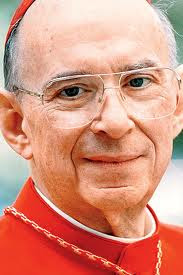 |
| Cardinal Bernadin |
In my lifetime, to my increasing regret, the Roman Catholic Church in the United States has lost much of its moral authority. It has done so largely because it has subordinated its teaching of Catholic moral doctrine to its ambitions regarding an expansion of the administrative entitlements state. In 1973, when the Supreme Court made its decision in
Roe v. Wade, had the bishops, priests, and nuns screamed bloody murder and declared war, as they have recently done, the decision would have been reversed. Instead, under the leadership of Joseph Bernadin, the Cardinal-Archbishop of Chicago, they asserted that the social teaching of the Church was a “
seamless garment,” and they treated abortion as one concern among many. Here is
what Cardinal Bernadin said in the Gannon Lecture at Fordham University that he delivered in 1983:
Those who defend the right to life of the weakest among us must be equally visible in support of the quality of life of the powerless among us: the old and the young, the hungry and the homeless, the undocumented immigrant and the unemployed worker.
Consistency means that we cannot have it both ways. We cannot urge a compassionate society and vigorous public policy to protect the rights of the unborn and then argue that compassion and significant public programs on behalf of the needy undermine the moral fiber of the society or are beyond the proper scope of governmental responsibility.
This statement, which came to be taken as authoritative throughout the American Church, proved, as Joseph Sobran
observed seven years ago, “to be nothing but a loophole for hypocritical Catholic politicians. If anything,” he added, "it has actually made it easier for them than for non-Catholics to give their effective support to legalized abortion – that is, it has allowed them to be inconsistent and unprincipled about the very issues that Cardinal Bernardin said demand consistency and principle.” In practice, this meant that, insofar as anyone pressed the case against
Roe v. Wade, it was the laity.
I was reared a Catholic, wandered out of the Church, and stumbled back in more than thirteen years ago. I have been a regular attendee at mass since that time. I travel a great deal and frequently find myself in a diocese not my own. In these years, I have heard sermons articulating the case against abortion thrice – once in Louisiana at a mass said by the retired Archbishop there; once at the cathedral in Tulsa, Oklahoma; and two weeks ago in our parish in Hillsdale, Michigan. The truth is that the priests in the United States are far more likely to push the “social justice” agenda of the Church from the pulpit than to instruct the faithful in the evils of abortion.
====== END QUOTE =====
Post Script: Later in the day, after perusing the turmoil in the Catholic and public radio and blog-s-sphere) about Rahe's article, I listened to one Catholic radio show host attempt to tear down Rahe's essay with arguments that are best described as
ad hominem,
strawman, and
equivocation/. This host criticize Rahe for being a blogger from nowhere, bitter, and inaccurate, and fallacious. I carefully studied Rahe's essay, reading each paragraph 2-3 times, looking for fallacies (which I know something about), and concluded that Rahe's perspective was credible and accurate, objective, and redemptive in tone, to say nothing of his credentials as an historian. You'll notice the essay takes us back to the
Magna Charta and moves forward through time, building a logical case for the bishop's failure to lead in recent memory, and giving over responsibility to the state, with advice and lessons for today and the future. Rahe also acknowledges that the bishops are doing a good job today. If you want, however, to "read" Rahe with some biased emotion, subscribe to Rush Limbaugh and listen to today's program from about 1:45 to 2:15 PM ET. It was a rush.


