Sunday, January 30, 2011

Ralph McInerny and the Wisdom of Fiction

From Daniel McInerny at his blog HIGH CONCEPTS a eulogy of this prolific father, Ralph McInerny, perhaps the most prolific Catholic author of fiction, non-fiction, and philosophy of the last few hundred years.  Click HERE for the entire post at Daniel's blog.

=======

In Dante and the Blessed Virgin my father articulates a truth that served as one of the most formative principles of his life as both philosopher and writer of fiction. That truth concerns what he follows Aristotle in calling “poetry,” Aristotle’s name for the genus of storytelling, of fiction. About storytelling, my father says this in Dante and the Blessed Virgin:
We become involved in stories because their characters are in some way ourselves. They are our better or worse selves, but not too much the one way or the other. We follow an imagined version of the choices that make up any human life, choices that matter. We are what we do, and characters in a story reveal who they are by their actions and choices. In real life, bounders succeed and the innocent suffer; they do in fiction, too, but the story makes sense of that in a way real life never does. Any story worth reading again will tell us something about the human condition we recognize as true” (21).
Read entire post.

Tuesday, January 11, 2011

An Open Letter to Christian Publishers and Producers about ENTERTAINMENT

Dear Christian writers, producers, publishers, artists, and other talent with a message to get out.


INSPIRE OR EXPIRE

As a producer, publisher and distributor of media products I am constantly approached by authors, artists and their representatives to assist them in either producing, publishing or distributing their products.

In the last few days I have been approached by five of these well-meaning individuals. One wanted me to make a movie about his idea, another wanted me to sell her music CD, a publisher wanted me to sell their book, and two others wanted me to produce videos to compliment their books. I have turned down all. One reason is that I have limited resources and cannot be engaged with everything that comes my way. But most of the time the idea is not good enough to engage customers so that the effort will turn a profit—a necessary "evil" in order to create jobs, support human dignity, and fund charitable efforts.

The books that I received for review have "inspired" me to write this blog. "Inspired" is in quotes because although the topics of the three books meet fundamental needs in society and are well-written they are emotionally (visually) unappealing. Yet, all three books supposedly target the lay reader or general public. Two of the three have attractive covers. But as soon as the books are cracked we are inundated with dry, long, explanations that only philosophers and theologians might appreciate.  They are void of visual appeal and emotional engagement. In short there is no entertainment value. 

It is very sad and frustrating to come upon great ideas (such as these books represent) that are so poorly executed by their publishers. You must be both inspired in the creation of your works (products) and you must also inspire the products use. If you don't, your efforts and your work will expire without effect. 

DESIGN TO EMOTIONALIZE

Something needs to be said about the state of most religious products that are "designed" to educate. They don't. Well meaning intentions are not sufficient, just like prayer is no substitute for talent or effort. As a Christian, in addition to inspiration (from the Holy Spirit or otherwise), you need both talent (natural or acquired) and effort (passion plus perseverance) to accomplish something good. Prayer alone results only in religious mediocrity. The mind must partner with the body -- the spiritual and psychological must be fully engaged with the physical realm. The WHOLE person must be involved in creating the product and in using the product.  Anything less is just that -- less.

Now in religious circles (especially orthodox Catholic and Christian circles) the term "entertainment" is nearly an anathema. There is this connotation that anything that entertains is probably evil. Well, folks, get over that misconception. You need to understand what "entertainment" is really about at both the cognitive and subconscious levels. Yes, it can be mindless enjoyment or escape. But  remember this when you're thinking that, the "mindless" fun WILL BE REMEMBERED FOR A LIFETIME.

Does that give you a hint at what you may be missing as a communicator and educator of ideas? You want people to remember things (and perhaps practice those things) for a lifetime.  To do that you need to create an adrenalin rush that burns your brain's synapses in a pattern that allows later recall. Without that emotional participation of the body, your audience will never remember a thing.

A simple way of explaining that is this: The user MUST first BE INTERESTED in the product for purposes of achieving a PERSONAL GOAL. In all successful stories the protagonist must have a physical goal or the story is lost on the audience. (TMP.) That is also true of our personal stories, our lives. People without goals becomes useless if not dangerous to society.  In our publications and mass media efforts such a goal related interest must be evident to the reader on the surface of a product for a person to even consider it. But it must run much deeper for them to buy it and continually use it and not let it sit on the shelf.  Below is a slide from one of my workshops. It's the Alison Fisher Purchase Funnel. We use it in story structure to explain romantic comedies. But it was conceived to help marketers and producers understand the buyer's perspective of the purchasing process.


For many marketers just the exchange of money for product is the producer's main goal. Whether they use the product is of a lesser concern. But for religious educators the physical purchase is not nearly as important as the internal application. So, if you're selling a book that you hope will change how a person relates to their spouse, you will not be satisfied unless a changed life results. Actual acquisition of the book is only one step to your end goal. So for religious publishers the "PURCHASE" in the funnel above has a deeper meaning. "Buyer commitment" means use and application.

What is instructive about the funnel for a creator of products is that the deeper you drill down into the funnel, the more emotionally involved you need the buyer to be. And I'm suggesting that emotional involvement means "entertainment value" and that means "SENSUAL."

SENSUALIZE

"Sensual" -- ah, another anathema term in Christian publishing. Well, let me properly (not popularly) define it for you.  Human beings are fundamentally sentient beings. "Sentience" is the ability to feel or perceive. We do that through our senses. Can you name all SIX of them. Yes, humans have SIX physical senses. The more of them you employ in your products as a communicator, the better you will communicate -- especially with men who need both ears and both eyes to connect their left and right brains. (That was not a slam, it's true.)  Okay, what are the SIX senses: Seeing, Hearing, Feeling, Smelling, Tasting .... and Balancing (most of us have an inner ear that allows us to stand, sit, walk and climb.) It's important to include this kinesthetic sense (which includes not just the inner-ear but the thousands of nerve endings that control our muscles to orient our body in space) because it is that ACTIVE sense which allows us to physically participate and do the good works God calls us to. It's also a lot harder to fall asleep when you're walking, running or jumping -- although I manage to have nearly perfected it as of late.

In real life all those senses are used, which is why "experience" is the best teacher. I like movies a lot because they involve many of the senses all at once, and can come close to simulating real life. In the Catholic Mass, Communion is the ultimate communication method. It requires the use of all six senses. Books create a special challenge because they are mostly passive. (The iPad and its derivatives are changing that.) But how does a book entertain, or emotionally engage? Here is a shorthanded list of what a good book can do to emotionally engage the reader:

1. Content - Relevant, Readable, Witty
2. Visuals - Bold, Colorful, Frequent
3. Layout - Logical, Varied, Spaced
4. Typography - Structured, Variety, Characterized
5. Binding - Secure, Easy, Protective

So, with that long introduction, to further reinforce my point, below is a cross-posting from my Moral Premise Blog titled FIRST ENTERTAIN. Does this apply to you?

===========================

FIRST ENTERTAIN

There's an adage in Hollywood, and similar industries, that says: "FIRST ENTERTAIN."

Successful entertainment, to me, is defined as emotionally engaging audiences so that they're willing to buy a ticket.

For me, the term "entertain" has an emotional element and a training element. (I'm sure this is NOT the word's etymology, but humor me.) Successful entertainment always emotionally engages your audience, AND it passes onto them some true moral message usually hidden in the subtext.  (For the girl on the right that truth is "Never, ever believe your mom when she says, 'Trust me, you'll love it.'")

So, we have something that is emotional (E) and we have a training element (TRAIN). That gives us E-TRAIN. Also there is the idea that both the emotional and the training enter into the person's consciousness and become ingrained. The key word there is ENTER.

So successful entertainment ENTERS into a person EMOTIONALLY and TRAINS them about something true. First ENTERTAIN.

Okay, Okay, so TRAIN and TAIN are not the same. Let me  s t r e t c h  it for ya. TAIN rhymes with STAIN, and good entertainment leaves behind a stain.... no, no, you potty head... a stain in your brain—a memory. (Geez! I can't take you anywhere.) Another way to understand it is that ENTER-TAIN is a lot like INNER-TRAIN. That is, something is "entertaining" because it has the ability to train our memories. The reverse is also true: if we want to train our memories there must be some emotional involvement, some entertainment. Memories do not "stick" without adrenalin burning some synapses together in our brain.  


The long of this short post is that successful communication has three components. It must ENTERTAIN, and for it to do that it must be MORALLY TRUE (at a psychological, spiritual, or subliminal level), and it must EMOTIONALLY ENGAGE (it must be be a visceral simulation of life).

That is what stories do better than a thrill ride at an amusement park, and what stories do almost as good as real life experiences (life's best teacher), but with out the physical danger.

(And you can believe the little girl above would feel a lot safer at the movies. Real life does have its drawbacks, especially when your mother is C R A Z Y!)

Thursday, December 9, 2010

Atheism and Miracles: Is It Really About Evidence?

Miracle, Fluke, or Not Enough Data?
My friend, Dave Armstrong maintains a very active apologetics blog, called Biblical Evidence for Catholicism (which covers much more wide-ranging material than its title suggests). In one of his articles, Dave reports on an interesting occasion when he was the guest of 16 atheists who tried to poke holes in his Catholic thinking. I guess it was a friendly dialogue, and not a typical angry debate, as such occasions seem often to be.

[Addendum from 7-17-23: Dave has now written over 4,300 articles and 53 books: the latest of which, The Word Set in Stone: How Archaeology, Science, and History Back Up the Bible (Catholic Answers Press: March 15, 2023, 271 pages), addresses many biblical "miracles" and proposes possible and perhaps plausible natural explanations for many. On his Philosophy, Science, & Christianity web page he also has several articles about miracles]

The center of their discussion was whether or not miracles have occurred in the past or can occur.  In particular they were discussing the Resurrection of Christ. This particular group, and one person in particular (DagoodS) found it difficult to discuss the plausibility of miracles because the group defined a miracle as an event that defied or broke the laws of nature.  Dave pointed out that unless the group could get off it's "no miracles allowed" mind-set, there was no chance to have an intellectual discussion regarding the possibility of miracles. That is, the firm bias of "miracles are impossible" prevents any intellectual investigation into the possibility of the same. It's like saying, "I choose not to believe in it, therefore it doesn't exist." My anti-Catholic children will say to me, "That's not what I believe" ... as if their ability to believe or not was the criteria for reality.

The Atheists' Beef with Miracles

DagoodS put his "beef" this way. I'm editing to pull together his salient comments:
As to naturalistic presupposition [regarding miracles]…I agree that is a difficulty for the [Christian] apologist to [objectively] discuss the Resurrection. Alas, it is part of human make-up. We all have biases. As a naturalist, I am going to look for a natural  explanation. As a theist, [the Christian would look] for a supernatural explanation.

Many apologists...appear to claim the evidence (for the Resurrection) is sufficient to ... convince a naturalist. In those situations, I try to explain why the evidence is not enough. Why we have legitimate (often un-addressed) concerns regarding the evidence claimed.
If I can interpret and expand for DagoodS (he can correct me):
Producing evidence in favor of miracles is not sufficient because the atheist will have legitimate concerns about the evidence. 
Of  course this is short hand, but is it the whole argument? Because it sounds like DagoodS is shutting the door before there's even a knock on it. It sounds like this:
Any evidence presented in favor of miracles would be illegitimate because the evidence is flawed...and we don't even have to test the evidence to know it's flawed.
Such is the character of prejudice and fallacious argumentation. The fallacy has two names in material logic: (1) Ignoring the counter evidence, and (2) Denying the counter evidence. Under the color of logic the atheist claims "I don't see it, therefore it must not exist."

Ah, there is the rub...and the solution.

Miracles and the Laws of Nature
The problem atheists have with miracles should be the same problem Christians have with miracles. The common definition is fallacious: An event that breaks one or more laws of nature.  Such a definition, if not pure arrogance, is a fallacious assumption. What follows in an explanation.

Let's start with one of Dave's favorite priests, Fr. John Hardon. In his Modern Catholic Dictionary (Eternal Life Publishing, 1999) he has this definition:
MIRACLE. A sensibly perceptible effect, surpassing at least the powers of visible nature, produced by God to witness to some truth or testify to someone's sanctity.
I don't expect atheists or skeptics to accept Fr. Hardon's definition. I provide it here for Catholics to help them see the fallacious nature of their definition. To understand why the common miracle definition is wrong, let's parse Fr. Hardon's definition. Note he says, a miracle is:
  • Something that is "sensibly perceived." That is, a miracle is not a vision or a dream that one or only a few see. A miracle is something that is commonly witnessed by everyone present at the time.
  • Is an "effect" - that means it is physical, not an "affect" which refers to the psychological state of a person.
  • The event or effect surpasses our understanding of the powers of visible  nature. That is the miracle APPEARS VISIBLY to contradict the laws of nature.
  • It is produced by God (not mankind)
  • It has a higher moral purpose. It's not just eye-candy or entertainment.
The important concept in Fr. Hardon's definition that applies to the current issue, is that the miracle visually appears to break the laws of nature.

Knowledge

As physicist (in part) and a Christian (hopefully, not in part) I have never believed that miracles need to break a natural law. The concept of "breaking a natural law" is that a contradiction has occurred. Natural Laws, however, are understood to be immutable and not exist in contradiction with one another -- something cannot be both TRUE and FALSE. Science would look at an apparent contradiction in nature and call it a paradox. That is, we just don't have all the knowledge about what is happening. Until we have most of the data we might call the event a phenomenon...and theologians and people of faith might call the phenomenon a miracle.  I submit, therefore, that miracles, which happen in the natural world, are paradoxes, not contradictions.  (BTW: The term contradiction is used in logic, for propositional statements that, to our thinking, are both true and false at the same time. )

In other words, when we "SEE" a contradiction we are mistaken, it is a paradox. The laws of nature cannot be broken, but they can be misunderstood.

Worlds in Collision

My thinking about miracles is informed by Worlds in Collision, a controversial book by Immanuel Velikovsky, in part, about the Plagues of Egypt (Moses). Velikovsky hypotheses that the miracles of the plagues were actually the natural result of Earth's collision with the tail of a comet. He explains them all as paradoxes. That does not make them less miraculous.

Another example is the fictional (but logical) account of the protagonist in "A Yankee in King Arthur's Court" who knows a solar eclipse is about to occur and uses it to his advantage. But such an event seems like a miracle or magic to the less knowledgeable characters around him.

Then there are the scientific and mathematical discovers of physical dimensions beyond the space-time continuum that can be described as 3 three physical (space) dimensions (length, height, and depth) and the thing we call the dimension of time, although we can only perceive a dot along the timeline, and not a full linear dimension as we do a ruled line on a piece of paper.  We cannot directly perceive the ten dimensions of space, but String Theory suggests they exists for certain mathematical and scientific observations to be true. Take for instance the spectrum's red-shift observations of deep space objects that indicate the objects are moving away from us a tremendous speed.  That movement is not in the three dimensions of space as we perceive it, but is on the surface of a 4th-space-dimension that is ever expanding. We see the effect but we can't see the dimension.

The existence of this 4th-space-dimension easily explains how Christ can seemingly appear to walk through a wall in the Upper Room, or how the Apostles and Christ can be appear to be transported instantly from one place to another. Or how the Red Sea is apparently parted. In all of these instances the laws of the natural universe are not broken, but rather we are allowed to physically experience what is always there. It's as if I go from bright sunlight into a dark room. For a while I can see nothing, until my eyes adjust, and then I see everything that has always been there. It's not a miracle. Things do not suddenly appear out of nothing.

All such "miracles" do violate our current understanding of Newtonian three-dimensions of space and time, but they obviously don't need to violate the laws of the universe when completely understood.

Monkeys and Witchcraft

This throws a monkey wrench into the atheist's arguments about needing "legitimate" evidence to "unanswered questions." In effect the atheist is demanding (or claiming) omniscience of the universe of knowledge. He is claiming to be, ironically, God. He is either claiming to know all or is expecting God to provide all knowledge. But that is something he will never have (unless he are "lucky" enough to get to heaven). Arrogance that he is important enough to have such knowledge cuts him off from God, who demands that we trust him for what our minds are too small to understand. "Now we see through a glass darkly..." Their illogical demand to be "god-like" in terms of knowledge (either now or at sometime in the future) cuts them off from the revelations that only faith and inform them about.

Did you see the "typo?" It wasn't. That last "and" was to be a "can". (See what mistakes and knowledge can impart?) Something does not make sense (like my last sentence) until new data is provided (it's a "can")  suddenly makes sense.  All human history is filled with such examples, especially in the history of science. What mankind thought was witchcraft of the 18th century is today "modern medicine" or "medical miracles."

Thus, the atheist, by his claim of of omniscience (there IS no God), and by his demand, "I need to know all to believe,"  errors on two fronts.  If he's honest, he "knows" he is not perfect, and that he is fully capable of making a typo.

Science Assumes Order

This leads "naturally" to the role of Christian Faith, without which few scientific discoveries would have been possible. Faith is irrevocably tied to scientific discovery because science assumes there is a natural order to be discovered. That is, science has faith that the universe is ordered and is not random or chaotic.  That order fulfills a mystical purpose is the scientist's assumption. That supposition allows science to use syllogisms to construct hypotheses, and then use logic to test them. The correct syllogisms lead to a constructive universe, not a destructive one. Without faith in a higher entity that designed and maintains the order, there is no purpose of the universe, and no hypotheses that can be tested.

Atheists are Logical Cowards

But we are sidetracked by all this talk of the need for evidence. What is really going on is this: Atheists hide behind the color of logic and evidence for fear of confronting the moral code of a just and gracious God. Atheism is a cowardly way to avoid natural law -- the natural moral code -- of the Creator. It's really not about evidence. Thus, the atheist isn't saying, "There are no miracles." or "There is no god," as if he was omniscient on that point. But he can say, and he has full right to it:  "There is no God -- Whom I will obey." Ah! Now that's evidence that makes logical sense.

Other References

C.S. Lewis is his book Miracles uses an argument similar to this, but different enough to be interesting. His premise is that due to humanity's lack of knowledge about the universe, natural laws should be perceived as laws about the way mater and time should normally interact, given our limited perspective of reality. But once new information or some new stimuli is put into the system of nature, natural law takes over and different (unnatural or supernatural) consequences result. Science is nothing more than the observation of nature and the construction of laws about what is observed. So, say we have a tank of fish, and we study them in this isolated situation and make up rules about their behavior. But one day we see something that is not "natural" in the fishes's world. That unnatural behavior, or supernatural behavior, may be the consequence of a new input to the system, and, after that new input, natural law takes over and we see the natural consequence. Thus, when Mary is impregnated by the Holy Spirit we have a new input into a natural environment...and Mary gives birth, according to natural law, nine months later.

Lewis makes the point I do above. No natural law is ever broken. Natural laws respond consistently to stimuli around them. What we see, which we call a miracle, is actually just a response of nature to a stimuli we have never seen before. 

Monday, December 6, 2010

The Books Are IN

I can't write much, there's too much to do. I have over a hundred books to ship tomorrow -- pre-orders for what finally arrived today. My video editing salon smells like a printing plant. Although packed in 139 boxes the 2,500 copies of WHAT CATHOLICS REALLY BELIEVE are still drying, after a 6 week journey by rickshaw, container ship, rail and truck -- from Malaysia to Michigan.  I conceived this book over three years ago, and I'm thrilled with how it came out. Thanks to Dr. Ray for helping it become a reality. It's the best looking and most readable educational book about Catholicism available anywhere. You bet I'm biased. See our inside the book and our specials HERE. Please tell your priests and religious education directors that we offer 50-60% discounts for quantity purchases for students. We ship around the world. Tomorrow I have orders going out to Australia, the UK, and San Juan, and there are already three copies in South Africa.


First Skid Off the Overseas-Transport Truck


Boxes stacked in the video edit salon -- warehouse is full.

WCRB Ready for Fulfillment

Thursday, December 2, 2010

In Praise of Being Alone - Tanya Davis

Tanya Enjoying Being Alone
Here's a great video in praise of being alone -- not hooking up, not being married, not joining a religious order -- but being alone. Years ago I wrote an article titled "Eight Reasons for Being Single". It was in defense of being celibate, whether lay or religious, it doesn't matter. I'll post it under the video that is really wonderful to watch. It features poet Tanya Davis, who reminds me of our daughter, April... also a poet. The production is very good, as well. Enjoy.


YouTube Link: http://www.youtube.com/watch?v=k7X7sZzSXYs

Eight Great Reasons To Be Single and Celibate
Written in 2002 and published on Catholic Exchange
Copyright 2002, © Stanley D. Williams, Ph.D.

A recurring objection to the Catholic priesthood is the requirement of remaining single and celibate. Our culture tends to look on singleness as a curse rather than a potential blessing. To bring some balance to the dialogue, here are eight great reasons to be single. As a Catholic you’ll find some of these reasons interesting, if not ironic, because they do not come from the pen of a celibate Catholic theologian, monk, or priest cloistered in a Mongolian monastery. Instead, they come from a Protestant-Evangelical minister, John Piper in his book RECOVERING BIBLICAL MANHOOD AND WOMANHOOD. John is married to Noel and together they have four children.

1. Marriage in not the final destiny of any human being.

Christ reminds us in Mark 12 that in heaven there will be no marriage, but we will be like the angels in heaven. If our ultimate goal is heaven, as opposed to marriage, then we must see that our ultimate state is as an angel who is not married.

2. Jesus Christ, the most fully human person who ever lived was not married, and he never once had sexual intercourse.

Modeling our life so completely after Christ’ singleness of life and purpose...in the words of Luci Swindoll “leads into a wide world of wonder and freedom and joy and love.”

3. The Bible celebrates celibacy because it gives extraordinary opportunity for single-minded investment in Ministry for Christ.

An unmarried man is concerned about the Lord’s affairs —how he can please the Lord. But a married man is concerned about the affairs of this world —how he can please his wife.

An unmarried person cherishes his or her freedom for flexible scheduling and for the ability to take risks that you could not take if you were a husband, wife, mother or father. The single life-style enables one to get the most out of the time God gives for His work. One missionary said, “One of my chief delights is that I don’t have to fit my ministry around a family schedule. I don’t have to be home at a certain time each night. My time is the Filipinos’ time.”

4. The Apostle Paul and a lot of great missionaries after him have renounced marriage for the sake of the Kingdom of God as Jesus. (c.f. Mt. 19:12)

Ada Lum, a single woman working with an Evangelical mission in S.E. Asia tells of sitting next to a nun while flying from Rome to Munich. Ada was impressed by the youthful enthusiasm of this nun who had been in the mission fields of the Philippians for 30 years and spent part of that time in a political jail. For the first time this single Evangelical missionary, who had considered marriage, saw the plain gold ring that most nuns wear, inside of which was inscribed, “Wed to Christ.” To the Evangelical the concept was new and exciting. Imagine being married to the creator of the universe.

5. The Apostle Paul calls singleness a gift from God.

“I wish that all men were [single] as I am. But each man has his own gift from God." (1 Corinthians 7:7) Although God created all of us for relationships we can have many healthy and fruitful relationships without marriage.

6. Jesus promises that forsaking family for the sake of the kingdom will be repaid with a new family, the Church. (Mark 10:29-30)

Singles have discovered the hundreds of family members in the body of Christ. April, our single daughter who is now 28, always wanted to have a lot of children. She thought she could only do that through marriage. But April is not married, yet she has a rich relationship with 20 children that she nurtures and calls her own where she teaches elementary school. We are regularly inundated with pictures and stories about “her kids” which have in turn become our grandchildren.

 7. God is sovereign over who gets married and who doesn’t. And He can be trusted to do what is good for those who hope in Him.


The Psalmist says, “no good thing does he withhold from those whose walk is blameless” (Psalm 84:11). Ann Kiemel Anderson wrote this poem: Jesus -- if this is Your will -- then YES to being single. -- In my deepest heart, I want to marry, -- to belong to a great man -- to know that I am linked to his life -- and he to mine.-- following Christ and our dreams together.-- But you know what I need.-- If I never marry, -- it is YES to you.

8. Mature manhood and womanhood are not dependent on being married.

We are either man or woman by nature. God gives us sexuality and a temperament to match. Who we are is based on his creation, not on our vocational decision. We are not made more fully man or woman by being married, or having sex, or having children. Your role as a single person is different than as a married person. But, don’t confuse your role with your sexual identify. Regardless of marriage, you are a full creation, with unique and particular passions, gifts, skills and talents. God, through Christ and the Church, has promised you a full life. All you have to do is respond to his call and say yes.

Wednesday, December 1, 2010

Yoga Jesus

Yesterday I recevied this comment from a person who had heard about our new book "What Catholics Really Believe" on the radio, checked out our website, and wrote us the following:
I...thought the book was just what I should get for a family member who has very little understanding of the faith.  However, the picture on the front is just too weird for me to consider buying it.  It reminds me of the pictures that the yoga people have of their "saints".  The picture of Christ that you chose has that same look.  I'm sure the book is great but the cover is a turn off.
I wrote back:
Thank you for your opinion.  You might consider that the yoga people adopted pictures of their leaders that purposely looked like Christ because he was so revered.
Of course I don't really know this. Other responses later came to mind:

a. "But you know that the picture on our book is Jesus. Right?"

b. "If Jesus looked like Uncle Fred whom I hate, would I also hate Jesus?"

c. "Do all men with long hair and a beard look the same?"

d. "Jesus and Yoga masters do have somethings in common... they're Eastern mystics who didn't have a razor or many friends who were barbers. 

Then, I wondered, what if this person is right and if all the Yoga masters looked like the cover of our book. That would be, ah, strange. So, I decided to do an image search on Yoga Masters, and came up with the images below. I suppose some people would see a resemblance. Which looks more like Jesus?

And what if our book cover looked so much like Yoga masters that Yoga people started buying it and reading it? Would that be bad? Would we get sued for impersonating Yoga Masters? I can see the headlines now: "CATHOLIC PUBLISHER SUED FOR DEPICTING YOGA MASTERS AS JESUS... OR THE OTHER WAY AROUND...THIS REPORTER ISN'T SURE."

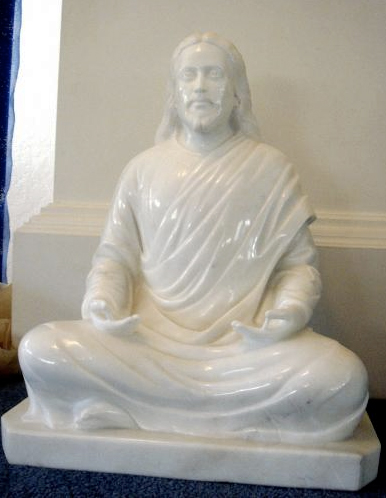
Ah, but then I found it. Yoga Jesus... in marble no less. Yep, that's Jesus alright. Well, okay, it's just a statute for you iconoclasts out there. It's not REALLY him. The website that has this picture claims:
The final marble statue which is of Jesus just arrived last week from India. Our line of masters or gurus is 5 deep (Jesus, Babaji, Lahiri Mahasaya, Swami Yukteswar and Paramhansa Yogananda) and Jesus holds pole position as you can see from Yogananda’s comment above. He is viewed by Yogananda devotees worldwide as a great Master of yoga.
Okay, so, I suppose this does look like Jesus. 

GUILTY!

Let's buy these books and save all these Yoga masters.


Tuesday, November 30, 2010

The Pope, the Palins, and the Pursuit of True Happiness

Kathryn Jean Lopez in the National Review threads common themes from the Pope, the Palins, George Bush, Dan Quayle, the Pill, the Condom, and Katrina. Thank you Ms. Lopez, great thinking, great writing.   It's HERE.

Considering the backdrop of eternity somethings are probably not coincidence. One of those might be the release on the same day of Peter Seewald's long form interview with Pope Benedict XVI, Light of the World, and Palin's American By Heart.

Wednesday, October 20, 2010

New Book - Three Years - BEAUTIFUL!

2,500 copies of our new book WHAT CATHOLICS REALLY BELIEVE is in boxes in a shipping container somewhere in the Pacific Ocean aboard the container vessel NYK Argus v.49E42 headed for Los Angeles. Then it's customs and transport to Michigan for warehousing and sale. A few dozen preliminary copies are being sold to some anxious customers and sent out to reviewers and our wholesale customers as samples. 

This unique volume, three years in the making, has the following features:

  • Edited for early teens through senior adults
  • Full dialogue text from Dr. Ray and Fr. Fete's television series.
  • Study questions for classroom or home study use.
  • Comprehensive Answer Guide by apologist-author Dave Armstrong , one of the most accessible writers in America today.
  • 127 Full color photographs by Fr. Gene Plaisted, OSC, of topical stained glass windows from churches around the world.
  • Ecclesiastical approval for publication was granted by The Most Reverend Allen H. Vigneron, Archbishop of Detroit, May 20, 2009.
  • 52 Sidebar definitions of often misunderstood terms
  • Flex-binding, that allows the book to lie flat on a study table
  • Comfortable size (8.5" x 6.5") and unique flexibility for holding in hands
  • Table of Contents with color keyed page-edge tabs.
  • Each unit is shrink wrapped to guard against cover wear and moisture.

Monday, October 4, 2010

NATURAL LAW and then there's "natural law"

Just got my absentee ballot for the November election. If you're over a certain age in MI you don't have to stand in line for an hour to vote. I plan on voting next week. As I scanned the ballot I saw a few candidates for the NATURAL LAW party.

Now, if you've read much of my stuff, you know I'm a Natural Law kind of guy. But I had not idea that the practical applicaiton of "natural law" could be perverted so much until I read this on Wikipedia:

The Natural Law Party (NLP) was a United States political party affiliated with the international Natural Law Party. It was founded in 1992 and mostly dissolved in 2004. Leading members of party were associated with Maharishi Mahesh Yogi, leader of Transcendental Meditation movement. 
I think I see where this is going.
The party proposed that political problems could be solved through alignment with the Unified Field of all the laws of nature through the use of the TM-Sidhi program. Its other policies were uncontroversial. 
This is funny stuff. Who wrote this? SNL?
"Natural Law" referred to "the ultimate source of order and harmony displayed throughout creation."
I like that. Catholicism is based on Natural Law... but this isn't the same. The question is how do you know what those natural laws are?  
Harmony with Natural Law could be accomplished by the practice of Transcendental Meditation and more advanced techniques. Due to scientific studies of these techniques, it considered this to be a science-based approach. 
The NLP proposed that a government subsidized group of 7,000 advanced meditators known as Yogic Flyers would lower nationwide stress, reduce unemployment, raise the gross national product, improve health, reduce crime, and make the country invincible to foreign attack. Hagelin called it a "practical, field-tested, scientifically proven" solution. 
Unbelievable. But it gets better. 
TM would be taught to the military, to students, in prisons, and to ordinary citizens. Hagelin predicted that implementation of the program would result in $1 trillion in savings from reduced costs for medical care, criminal prosecutions and prisons, national defense, and other government expenses.
Catholicism would do this if everyone just went to confession once a year.  Just teach people to live a morally chaste life and you've got it. Anybody got any ideas on how to do that? .... don't tell me, TM.
Slogans included: "Only a new seed will yield a new crop", and "bring the light of science into politics". Catchphrases included: "prevention-oriented solutions" and "conflict-free politics".
Love that last one, "conflict-free" politics. Would it really be politics, then?
LITURGY TO CULTURE

I have given up trying to articulate my many thoughts on this topic... at least until the mind melds in such a way that I can make sense. In the meantime, my good friend and editor a Catholic Exchange, Mary Kochan, sent me a link to an interesting and well written review of sociologist PHILIP RIEFF life work by David Lewis Stokes. I'll quote a bit then give you the link:
In antiquity the ideal of what it was to be truly human was to become either hero or sage. In the Middle Ages it was to become a saint. In our own time the best we can hope to become is — well-adjusted.

By the end of the 19th Century Jesus had ceased to be an apocalyptic rabbi or the God-man, and had become our primary therapeutic figure: Jesus is now the One who cares.
In 1965 Rieff’s “Triumph of the Therapeutic” was received as the work of a brilliant and urbane sociologist. Now with the posthumous publication of “Sacred Order/Social Order” — a three-volume meditation on art, history, religion and culture — we find ourselves confronted by a contemporary Jeremiah, who doesn’t hesitate to pronounce our most cherished cultural orthodoxies as “deathworks.” Rieff is a prophet of such subversive power that he’s sure to be sentenced to our equivalent of being hanged, drawn and quartered: He will be catalogued, shelved and ignored.
Whatever our own fate, we do well to commend Rieff to God. But may his soul, at least for the time being, never rest in peace.
Rieff's Search for a Way Beyoond our Therapeutic Culture