Friday, June 30, 2023

My Motivations for Writing "The Wizard Clip Haunting" Novel

In preparing remarks for book talks that I plan to give in the coming months, you may find this segment (5. Motivations) of historical interest. It is the principle reason for my ten-year effort to finish the novel.  Your comments are most welcome.  (Stan Williams)

5. Motivations

My writing of The Wizard Clip Haunting was significantly motivated by what is generally unknown about the persecution of Catholics in England, Ireland, and how that persecution came to the British Colonies and became imbued into the culture of the United States. Let me review the history of the British contribution to the Protestant Reformation that has so imbued American culture to this day. A great deal of what I’m  going to share is reflected in the novel as the prime motivation, not just for me the writer, but as the deep seated motivation for many of the Wizard Clip characters. My hope is that the novel will shed light on the origins of our culture and encourage us to avoid the prejudices of the past. 

I grew up being taught that America was established as a safe haven for religiously persecuted Europeans; particularly which religious sects were being persecuted and by whom I was unsure. I did know that the Pilgrims and Puritans, for some reason, were at odds with The Church of England, but I didn’t know much more than that. 

As a teenager in the 1960s in the Midwest, I recognized a strong bias against Catholics who lived in our suburban neighborhood. I didn’t understand this completely, except for what my mother inferred...that the Catholics were idolaters, not Christian. That my school chum next door was Catholic had something to do with it, in so far as he took after his Dad who drank a lot of beer, smoked packs of cigarettes, and swore a lot. It didn’t take much to persuade me that my mother was right. 

Penal Laws  - UK & Ireland

But it wasn’t until my college years that I became aware of the 17th and 18th century British penal laws, which outlawed all things Catholic, even to the point of imprisoning citizens, confiscating their land and possessions, animals, heritage rights, and executing priests who refused to be exiled. The penal laws also made celebrating the Catholic Mass and  transubstantiation illegal. Other laws barred Catholics from voting, holding office, owning land, bringing religious items from Rome into Britain, and prohibited the publishing or selling of Catholic materials. 

I had no idea about any of this. It surprised me. More research was clearly necessary. 

The source of the penal laws was Henry VIII and his political and moral battle with the Vatican when Pope Clement VII refused to annul his marriage with Catherine of Aragon because, due to miscarriages and still births, she had not given him a male heir but only one daughter, Mary. In 1529 Henry banished Catherine from court, and persuaded his political fixers to arrange his marriage to Anne Boleyn, which they did.  

The next year, in 1530, Henry took revenge on the Vatican. He convinced parliament to start work on a series of laws that would come to be known as the penal laws. Over the coming years they:

  • Established Britain’s break from Catholicism
  • Confiscated all Catholic property, land, monasteries, convents, and possessions 
  • Made Henry the head of the newly formed Church of England
  • Outlawed Catholicism in English life, and 
  • Transferred significant wealth from the Catholic Church to the English Crown. 
  • After that, it was only natural for Pope Clement VII to excommunicate Henry, or we might say, Henry VIII excommunicated himself.  

The penal laws were refined and expanded over the years, and eventually implemented in Ireland, which dramatically affected the life of several main characters in the novel.  There were, however, attempts to mitigate the laws during the reigns of Catholic monarchs Mary Tudor (1553–1558) and James II (1685–1688). 

In the early 17th century, certain British Catholics, although persecuted, were not idle. During the reign of Protestant James I, a group of Catholics tried to assassinate the king and the House of Lords in what is known as the Gunpowder Plot. On 5th of November 1605 the plot was foiled and several of the Catholic rebels were executed including the man guarding the explosives in the undercroft of the House of Lords. That man was Guy Fawkes. Thus, every November 5th in England, and even in the British colonies, groups of Protestants celebrated the foiling of the plot with Guy Fawkes Bonfires where they burn the Pope in effigy. During America’s Revolutionary War, General George Washington, recognizing the sacrifice many Catholics were giving to the war effort, tried to ban the celebrations, but he couldn’t change the culture.

The penal laws lasted roughly 250 years. With the Roman Relief Act of 1791 and others through 1926, the penal laws were finally, but not completely, nullified. In 2013, the British parliament passed the latest of these relief acts which allowed the spouse of the king or queen to be Catholic, but never the monarch, who must be Protestant.

A personal story illustrates the lasting effect this all has on culture today. In 20-03 I was traveling in England on business with an associate. We took a half-day off to tour Nottingham and St. Mary’s Church, which dates back to Saxon times. Recognizing us as American businessmen and tourists, we were being given a tour by the older but very gracious and considerate church sexton. He had just lifted the floor board near a pillar to show us the original Saxon rock foundation when my associated casually mentioned that we were both Catholic. Immediately, the sexton, raised up, glared at us, slammed the floorboard back into place, and stomped off. My associate turned to me and whispered, “Was it something I said?” 

To this day, since America was initially British, the penal laws and their legacy are well ingrained into British and American culture. 

Penal Laws - British Colonies & the United States

One of my favorite stories of this period is the Maryland experiment. In 1632 Lord Baltimore (George Calvert) was granted possession of all land lying between the Potomac River and the Chesapeake Bay. Lord Baltimore saw this as an opportunity to grant religious freedom to the Catholics who remained in Anglican England. Lord Baltimore died within weeks of his land grant, and so his first son, Cecil at age 26, took charge of forming the new colony, and sent his younger brother, Leonard at 25, to the New World to establish the Maryland colony with a small boatload of Protestants and Catholics, including a handful of Jesuit priests.

At fist laws were passed in the Maryland colony to give religious freedom to every one. But by doing so, the experiment didn’t last long. Soon, the population of Maryland became predominately Protestant and the Catholics were chased out of power, new laws were passed, and Catholics found themselves under penal laws once again, except they often were not enforced with severity. In 1692 the Episcopal church was established by law in Maryland. Acts were passed to prevent the growth of Popery. Priests could not say Mass, nor teach, nor perform any religious rite. Rewards were offered and imprisonment inflicted. One hundred pounds was the fine or sending a child abroad to be educated in the Catholic religion. Catholics refusing to take an oath against Catholicism forfeited their land. In 1734, Catholic worship was prohibited in Pennsylvania, and so on. Even after the Americans won the Revolutionary War, and the Constitution and Bill of Rights took effect there was still a crazy quilt of state laws regarding religion. In Massachusetts, only Christians were allowed to hold public office, and Catholics were allowed to do so only after renouncing papal authority. 

In 1777, New York State’s constitution banned Catholics from public office (and would do so until 1806) and priests were still sought out and murdered by Protestant belligerents. In Maryland, Catholics had full civil rights, but Jews did not. Delaware required an oath affirming belief in the Trinity. Several states, including Massachusetts and South Carolina, had official, state-supported churches.

While some of America’s early leaders were models of tolerance, American attitudes of the general public were slow to change. The anti-Catholicism of America’s Calvinist past found new voice in the 19th century. The belief widely held and preached by some of the most prominent ministers in America was that Catholics would, if permitted, turn America over to the pope. Anti-Catholic venom was part of the typical American school day, along with Bible readings. In Massachusetts, a convent—coincidentally near the site of the Bunker Hill Monument—was burned to the ground in 1834 by an anti-Catholic mob incited by reports that young women were being abused in the convent school. In Philadelphia, the City of Brotherly Love, anti-Catholic sentiment, combined with the country’s anti-immigrant mood, fueled the Bible Riots of 1844 in which houses were torched, two Catholic churches destroyed, and at least 20 people were killed.

All this in spite of the Bill of Rights and the First Amendment of the Constitution which were ratified 53 years earlier in December 1791. Culture is often more powerful than laws.

Since researching and becoming Catholic myself in 1998, all of this information fascinated me. I wanted to somehow communicate how it was that Catholicism was trapped in a gulf of prejudice – which had originated with an egotistical and adulterous British king -- and had infiltrated the culture of Protestantism, in which I was raised. 

In 2012, the Wizard Clip story was pitched to me as a movie idea, and I wrote a screenplay. I also began to research the background of the various characters—the real characters in the story—and I saw the depth of anti-Catholic bias and persecution that underscored and undergirded the Wizard Clip story. 

In 2014 curiosity of some of the real characters motivated me to traveled to the Catholic archives in Baltimore, Maryland, and then trips to Middleway, West Virginia, Pittsburg, and New Orleans. Between a great many other projects, I poked away at the story’s plot and character back stories. Slowly, a large novel developed. Friends tried to persuade me to keep it short, but to tell the whole truth, and develop the characters so that the climax of the story made sense, I committed to telling a well-rounded and full story, being faithful to what I understood to be true, even if the gaps were imagined. 

Tuesday, April 25, 2023

Looking for PBS Documentary Funding

Pam and Stan Williams with Fr. Dwight Longenecker
after Mass at Our Lady of the Rosary Catholic Church
in Greenville, S.C. 


Do you want to dramatically transform society’s perception of the supernatural? Do you want to shift culture’s values from materialism to the transcendent? Our project is a simple yet exotic effort with far reaching, long-lasting effect. 

We need help funding a relatively inexpensive PBS television documentary through our two public charity fiscal sponsors. We have the professional experience, the local knowledge, and PBS’s support to carry this off...but we need several funding partners who will also benefit from the PBS exposure. 

Here's the hook, the question, that will catch the interest of millions of viewers...viewers who are culture’s movers and shakers. 


Why are seven (7) European and Near East, inaccessible monasteries, plus a dozen other religious structures, some built as early as the sixth century and all related to St. Michael the Archangel...in a perfectly straight line pointing at and terminating at a prophetic location in the Holy Land? 


The alignment is uncanny and striking. The question about their alignment has stumped historians and archaeologists for decades. But we think we know the answer, an answer that is out of this world, literally...and no, it has nothing to do with aliens from another planet. Common folk and experts wonder if there is a meaning to the mystical alignment. We think there is...and yet the original builders would have had no idea.


  • Were the monasteries built along an astrological alignment with the stars?
  • Were they built to align with the setting sun on the summer solstice? They do, but does that mean anything?
  •  Perhaps the monasteries were built on sites where mystical energy fields emanate from the earth's crust?
  • Is there a magnetic alignment or resonance with hidden veins of iron ore beneath the surface?
  • We do know that some of the monasteries were built as way stations for ancient pilgrims on their way to the Holy Land. But is there archaeological evidence that without the advantages of today’s navigation technology such construction could have resulted in an alignment with other monasteries hundreds or even thousands of miles away? 
  • Were there perhaps some unknown primitive technologies, such as those used to build the pyramids, that could have been used to align these sacred buildings on the top of mountains?
  • Perhaps there was a secret code passed down through the many legends about St. Michael appearances that monks discovered or passed around to effect the alignment?
  • Or, is the alignment purely coincidental—a solution looking for a problem as material atheists are quick to claim?
  • Yet, in the end, to what extent is the alignment of supernatural origin? Could the alignment of these gigantic buildings, in visible but inaccessible places,  be the obvious evidence that a transcendent reality exists? Is the alignment evidence that cannot be ignored that God is trying to get our attention?


Our research has taken us to all of the monasteries on the line, and several additional sites across six countries—one being the source of the legendary Sword in the Stone...which actually exists and of which St. Michael had a part. We’ve interviewed archaeologists, historians, and locals, and we’ve collect and catalogued terabytes of high resolution video. But we’re far from done. Some would say we’re in the midst of an eye-opening production, a Eureka moment in history! But no one else will know unless we get help.


With proper funding we can commit to real putting subject matter experts on camera and asking them tough questions— astronomers, archaeologists, historians, anthropologists, astrophysicists, geophysicists, geologists, and a monk or two ... who can help us answer the alignment question and shove society’s heart back to reality. 


Do you know a foundation that will help?


More information is available our project website.

https://stanwilliams.com/ANGELQUEST/ or write to me at stanwilliamsphd@gmail.com


Thank you.


Stories as Theo-Drama


This post may make little sense. I'm writing it so I don't forget something.

A friend recently introduced me to Hans Urs von Balthasar's Theo-Drama Theological Dramatic Theory. That's actually an over-statement. I have not read Balthasar's epic five-volumes, although they sound fascinating. I may never read them. Long theoretical tomes put me to sleep. The books are also expensive, which is just as well because I've run out of bookshelves. All of that is nonsense, however. From the short reviews I've read Balthasar's Theo-Drama meshes well with my own The Moral Premise.

In short, ideas, theories and theology only matters when action is taken.

Or, in terms of an oft repeated writer's adage: show don't tell. 

Another has said, "Intentions do not matter. Right and wrong live in the realm of action." 

Channeling another writer:

We know nothing about God—only what he did. 

And, from some long forgotten playwright:

All the world's a stage
and all the men and women merely players;
They have their exits and their entrances;
And one man in his time plays many parts,
His acts being seven ages. 

In a screenplay or stage play there are six grammatical elements: Scene-heading, Action, Character, Parenthetical, Dialogue, and Transition—but only two really matter—Action and Dialogue, the actions of moral agents—what they do and say.

It seems, therefore, that all that matters are the "acts" of the characters on stage or screen. 

By extension, theology only matters when moral agents act. (Yes, yes, of course, Jesus warned us of the sin of envy, jealousy, lust can be in the heart (mind) a sin. But then, in God's transcendent justice invisibles are real. But that's God, not human agents who can only judge acts and not thoughts...although they try. 

What does this mean?

It means that stories of humans taking action and suffering consequences are works of theology.


Monday, April 17, 2023

The Wizard Clip Haunting Review by Marueen Wahu

It's a New Day!

Since the dawn of man and Lucifer’s shameful expulsion from heaven, Lucifer has tried endlessly to put God and man at odds with each other. Such is the story of Adam Livingston.

Adam was never a man of great faith, but his wife, Esther, was a strong believer. Together they weathered many storms as bereaved parents of one living child and several others who died pre-term. Finally, God blessed them with two healthy children who would live to adulthood, but the devil had marked Adam for the purpose of destroying his faith. It was his intent that Adam would curse God before he died.

It’s for this purpose that he petitioned to take Esther’s life and his petition was granted. The plan was working already. Adam, who had little regard for the supernatural despite having the gift of prophecy, became evermore determined to control the outcome of his life.

On top of losing his wife, Adam would have to give up his farm. It was a wedding gift from his father in law deeded to his wife. He could not continue to farm it, but he could sell it and keep half the proceeds. Thankfully, his own family would keep him in the flax farming business one way or another. His father proposed to sell him a piece of land in Virginia and he took the offer. Little did he know that he was heading towards the final battleground. In this place he would either curse God and die, or accept him and receive his mercy.

The Wizard Clip Haunting, is a historical fiction with elements of a supernatural thriller. It describes in detail the haunting of the Livingston property; their mansion, their barn and their farm. It introduces us to the possibility of animals being protagonists for either good or evil. It also sheds light on the power structure within which demons operate. I found the author’s way of exposing satan’s intent very entertaining and innovative.

The only gripe I have with this book is it’s championing of the Catholic faith. I’m a protestant myself and disagree on some doctrinal matters. However, I still found it entertaining and educational. It’s my hope that if this book convicts you to be a Christian, and that you follow the teachings of Christ as your life’s manual.

Grab yourself a copy.

Thanks for stopping by!

Maureen

Link to Original Review


Tuesday, March 7, 2023

Anti-Woke Answers to Prayers

Everyday I pray that evil in our culture and society will be overcome and what is GOOD, TRUE, and BEAUTIFUL will prevail under God’s almighty hand. For seven years I’ve harbored ill will toward the whole “political correctness” movement. I saw the faux politeness as an insidious effort to undermine truth. The problem was evident in every sector of the culture and even in the Christian Church which was a major problem, for under the “political correct” model where offense of any kind was to be avoided, the Church was becoming tolerant of evil. The backlash against political correctness is what contributed to the popularity of Donald Trump who made mincemeat of miscreants who were lauded for their polite behavior. 


Daily, I find myself scanning the news for answers to my prayers for conversion of the malevolent, or for God to re-erect Haman’s gallows (Book of Esther), or to read about evil-doers who fall into their own traps (Proverbs 29:6).


In the past year I have seen many answers to these prayers as misled titans of corporate, education, and media institutions have fallen or reversed course back to what is true. The riots in Seattle and Portland reminded me of Romans 1 where God gives over the perverse to the desires of their hearts. The fall of Harvey Weinstein, Jeffrey Epstein and associates, Nancy Pelosi and and more recently Alec Baldwin are modest examples. The recent changes at CNN which Christopher Licht is forcing upon their show hosts, and the recently discovered backbone at the New York Times to tell the truth are also examples. Then there’s the Elon Musk’s takeover of Twitter and the Twitter Files that are taking on Biblical proportions. 


Three more examples that came to light this morning. 


1. While I’m not a Chris Rock fan, nor any longer a Netflix subscriber, Ben Shapiro points to the significance of Chris Rock (and other comedians like Dave Chappelle) who are finally ditching the wokeness which they were all plagued with several years ago, and are boldly attacking the woke culture with truth. Shapiro sees it as a true sign of an anti-woke revolution. That Chris Rock's comedy special where he revisits the Will Smith slap, has the strong backing of a major liberal-woke corporation (Netflix) is a good sign than the culture is changing and it may in fact bleed down into politics.


Jacob Chansley is seen outside
the U.S. Capitol in Washington on
Jan. 6, 2021. (Brent Stirton/Getty Images)
2. With the U.S. House of Representatives being taken over by Republicans under Kevin McCarthy’s leadership, a major breakthrough occurred in the last week when McCarthy released ALL of the January 6 Capitol security footage to Tucker Carlson. Bombshell…the footage, held secret by the Democrats, proves once again that the Democrats were lying.  The vast majority of the video (some 40,000 hours worth) proves that the January 6 protest was not an insurrection, as the Democrats claimed by selective release of the video. The vast majority of the video demolishes the insurrection claim the Democrats used to attack their political opponents. 


3. Many corporations and universities (even Christian universities) have formed DEI (Diversity, Equity, and Inclusion) departments in a woke effort to ensure they are not lambasted by the social media mavens over claims of racism and prejudice. But in fact DEI efforts, which disparage and act as gatekeepers for hiring and admitting individuals based on merit, are nothing more than racist and prejudicial at their core. The DEI movement has been active since 2017 but recently there are reports that corporations and educational institutions are seeing the falsehood that DEI creates. 


When inflation hit this year, corporations were quick to layoff and stop their DEI trivialness. 


See: https://www.businessinsider.com/layoffs-diversity-departments-some-ceos-talk-committed-racial-justice-2023-2


Then, the University of Texas and Texas A&M remove all DEI considerations in hiring and admissions. 


See: https://www.statesman.com/story/news/education/2023/03/03/diversity-equity-inclusion-texas-am-system-hiring-admissions-ut-system/69964633007/


4. Ah, another...they keep cropping up: Liberal comedian Bill Maher continues to chip away at the false narrative of the woke culture by confronting one of its most vocal adherents, Bernie Sanders, here face to face about Biden’s Student Loan Forgiveness proposal.  Bernie Sanders is left speechless:


 I will keep praying, as are millions of others, that God will remove the snake scales from everyone’s eyes.  

Sunday, January 29, 2023

Huh!? A Christian Novel about Occultist Hauntings?


NO SPOILER: This author's accounting of
The Wizard Clip Haunting contains no spoilers.

After 10 years of on-and-off again effort, I recently finish writing an historical novel based on the well documented Wizard Clip Legend out of what is now West Virginia. 

The resulting book, now available in several editions, is titled The Wizard Clip Hauntings: A True Early American Ghost Story. The novel is necessarily long, due to the Early American history that pervades the time and place of the events that shocked many, and even involved the first United States bishop, John Carroll, S.J. 

At the time, what Adam Livingston and his family experienced was disturbing. Remembering them, (especially in fictional form) can likewise raise disturbing questions. So it was, that I received a sincere email from a Catholic friend who asked an honest question. Here is an excerpt of her letter (the bold emphases are hers).

Hi Stan, 

I hope we can buy your book soon. But I have some questions before we do. I am curious about the topic of hauntings. Just to be clear, and forgive me of my ignorance, but I assume this is safe for a good Catholic to read. I avoid anything that would lead to the occult. And any of its dealings. How do you justify the topic as a devout Catholic? 

I am sure that it is me who is not clear on this, and not you. But could you touch on helping me understand the purpose of writing this book and its benefits?

My husband is intrigued by a bit of this type of topic usually, I am not. But I seem to be this time. 

Hope my question makes sense to you. Thanks for any clarification you might offer me. God bless! 

F. 

I wrote our friend back with an answer that I will expand here:

 Dear F,

Thank you for asking a very good question. I thought about this very dichotomy years ago when I started the project, but not recently. Your reminder prompts me to revisit my motivation. 

The Wizard Clip Haunting is, at its heart, a tale faithful to Catholic teaching. But, because the core story is true and unexpected in several ways, it has also become controversial. The combination of truth and controversy (a great dramatic irony) drew me to it.  Without fictionalizing the historical aspects of the story, a great truth of Catholicism is explicated, and hopefully, my fictional additions do it in an entertaining and narrative way. Professionally, I'm a storyteller. I would much rather explain truth by telling an ironic story than writing didactic apologetics or theology. While I have been accused many times of the latter, I much prefer the former. So I wrote the novel because it tells the truth and can inform readers about the reality of heaven, hell, angel, demons, and what we need to do to live successful under God's grace and within his mercy. 

THE HISTORY 

The core of the story is historically well-documented mostly by several Catholic priests, and the U.S. bishop who were involved in the events in the 1790s in what was then northeast Virginia.  Over the years, the story has been told over and over, and consequently has garnered the label of a legend because the various accounts recount the details differently. The core of the story, however, remains unchanged. 


The story, in real life and in the novel, is told by Fr. Demetrius Augustine Gallitzin, an eye witness to the Wizard Clip events who was known during his lifetime as the Apostle of the Alleghenies. Today, he is known by the Vatican as "Servant of God." A former Russian prince, he was the first U.S. Catholic priest to complete all his seminary training in the U.S. and be ordained by Bishop John Carroll. To fit in with early American society, he took the name Fr. Smith, but his thick European accent—from knowing five languages—gave him away. 


Without giving anything away about the novel, the story is not one, but four, woven into a single fabric no doubt by Providence. The first story, regards a 35-acre plot of land that today is known as Priest Field, a Catholic Retreat Center. The second, is the story of a resourceful but tragic farmer, a lapsed Lutheran, known to history as Adam Livingston. The third, is the story of a pioneering priest, Denis Cahill, who founded six parishes that exist today. He forged an heroic missionary path in the early days of the nation, but then lost his way. The fourth, is of a demonic spirit, which the locals to this day call the Clipping Wizard. 

The village where the events took place is known as Clip Town. Today, over 200 years later, the village of Middleway, WV, continues to celebrate its place in history with wood-block badges on the fronts of the historic buildings depicting a crescent moon and a pair of scissors. 

You can read more about the story, or buy one of the editions of the book, at the book's website: https://wizardclip.stanwilliams.com


Tuesday, January 10, 2023

Jordan Peterson on Belief in God

 This is better than most (if not all) homilies or sermons I've ever heard from a Protestant or Catholic pulpit. Peterson is clearly the prophet that our Christian leaders have failed to aspire to. God calls all sorts to reach all sorts. In our mixed up world Peterson is the Billy Graham of our day. 


Fifty years ago I would have said the same of Stanley D. Walters. In 2020 we published Dr. Walter's book BASIC CHRISTIANITY. Below is an example of the way Walter's thinks and presents the faith. This is a visualization of his Lecture 4: Getting Information About God. It's me (Stan Williams) on camera, but the words are Walters'. 


Sunday, November 20, 2022

Letters on Liturgy - Fr. Dwight Longenecker


Click on image or publisher's site.
A significant crux of my conversion to Catholicism was    my dissatisfaction with Protestant- Evangelical worship. It always seemed narcissistic to put it in modern context. That is it was (and still is I assume) people centered. We sang songs "about" how "we" experienced him; they were not songs "to" God and how "He" objectively was.  The choir, piano, and organist were up front, on stage, like performers. When they performed we watched "them" and evaluated their performance. This is especially true today with the pop oriented "seeker" church movements with bands and drama performances on stage or video screens. 

Most egregious to me was the hour long sermons with the preacher demanding our attention. No, there was something more egregious to me: the lack of inspiring art on the walls, ironically rejected by my evangelical upbringing because there was a misguided claim that art drew our attention to the artist not to the subject of the art. This was a strange view since we hardly ever knew who the artist was, even if there was a name microscopically inscribed in the lower corner.  And the most obnoxious element of protestant evangelicalism (lower case on purpose) was the architecture, or lack of it. There was nothing about most churches (except perhaps the Crystal Cathedral) that lifted the soul upwards toward heaven. Visually the evangelical protestant churches were stuck to the wrong side of the iconoclastic heresy of the 700s. God was a good friend, my buddy, a chum, not the almighty. majestic, invisible creator behind the universe. 

For reasons I can only guess, my understanding of God was always one of awe. That may have developed because of my exposure to nature and the intricacies of creation and the wonder of the heavens; astronomy was an early hobby that mesmerized my imagination. 

Old St. Marys in Detroit, MI
Catholicism, and the Mass changed all that for me. Suddenly I was introduced to a way to worship God that  more befitted my (yes, it was still about my sinful perspective) view of who God was and how we should approach him. The longer I was Catholic, however, and attended a variety of Masses in various churches in the Detroit, MI metropolitan area, I saw elements of Protestant-Evangelical worship that turned me off. Some Masses (at particular parishes) were too friendly, and too "us" focused.  The music was pop, cheesy and trite. There were a couple of churches where the sign of peace became a party with everyone leaving their pews and wandering about the nave shaking hands, hugging, talking, and creating a vast disturbance just after the consecration of the wine and bread into the body and blood of our Lord. It was incongruous and distracting, it turned our attention from God to each other.

In recent years I've gravitated to the Tridentine Latin Mass, and I only wish there was a church, a gothic styled church, near me that celebrated it. The downside of a Tridentine Mass however, is that I can never follow the liturgy and thus worship with my mind because the priest never says much of anything out loud, except the homily, and when things are sung or said aloud, it's in Latin, which I don't understand. And the missals don't help. I've been to dozens of Latin Masses and the missals they hand out or that I bring with me are of little help. If the priest doesn't follow the missal in my hands exactly, I'm lost. 

Alas, I see that this post has become a narcissistic outlet appeasing my melancholy-choleric nature. Let me shift.

Pam, Stan, Fr. Dwight after Mass at
Our Lady of the Rosary, Greenville, SC

The parish I would most like to attend is Our Lady of the Rosary in Greenville, South Carolina pastored by Fr. Dwight Longenecker. Just one problem...it's a 12 hour drive away. Many have moved to Greenville SC, however, with their large families because of this parish and their school. Pam and I have relatives in town and we've been there a few times. The Sunday 10:30 AM Mass is SRO. If you're late you get a chair in the aisle or foyer. Many of the families have a pew full of children. Fr. Dwight celebrates a New Order Mass, but there's a bunch of Latin thrown in, with an excellent schola choir and pipe organ in the balcony, and he celebrates the Eucharist ad orientem, with the people and the priest facing East together. Yes, the new church was deliberately built so the people and the priest face EAST during Mass.

This post is supposed to be about Fr. Dwight's book Letters on Liturgy (LOL). So, I'll finish with a few words about it. I've only read five of Fr. Dwight's 30 or so books. They're all good. He's easy to read. I can identify with him for a number of reasons including his easy non-technical choice of words, his Evangelical roots, his love for orthodox Catholicism, his preference for art (he was an art major before he turned to theology), his love of good stories, and no doubt because we're working together to produce a major television documentary on St. Michael's Sword

I wish more Catholic priests would read LOL and put the ideas the book contains into practice. Am I being narcissistic? No doubt, why else would I have a blog? (I have several, actually.)

In the Foreword to LOL, Archbishop Salvatore Cordileone writes: 

This work is nothing less than a practical resource for priests to realize in their life and ministry the apologia for Christianity that a defiant world truly needs and unconsciously years for: the production of art from the Church's womb that mediates the presence of the sacred, and the witness of saints who personalize the power of the truth, beauty, and goodness of the transcendent majesty of God. 

Some quotes from LOL:

First Thoughts

...traditional Catholic worship is iconic...every person, every action, every vestment, every point of art and architecture, music and liturgical text functions like an icon—a door into the invisible realm of God's presence." (p 21)

Sacrifice or Sacred Feast 

The Extraordinary Form of the Mass is the Mass of the Ages and it therefore transcends particular time-periods and cultures. A traditional church building, Gregorian chant, traditional trained altar servers, and a traditional style of celebrating the mass rise above all our individual tastes, cultural influences, fashionable ideas, and political ideologies.  The very antiquity of such a liturgy gives it a transcendence that cannot be denied. (p 34) 

Priest: Wimp or Warrior? 

The priest must be a warrior, not a wimp. He is a man of sacrifice. He is one who hears Jesus Christ say, "Take up your cross and follow me," and "unless you take up your cross and follow me you cannot be my disciple." The way the priest does this is by offering the sacrifice of the Mass with due reverence and awe... (p 43) 

Celebration of the Mystery

Through the ritual we connect with the ancient truths in a symbolic and unspoken way, and it is through this language that we worship best. (p 53)

On the Mystery of Language

Worship is the way we step into the other side of reality. (p 59) 

Words, the Word, and the World

People need to see and hear how the faith is real in the lives of real people. [Therefore] Faith stories incarnate theology. Faith stories make real the truths you are preaching. (p 74) 

Plays and Playtime

It was through religious ritual, drama, and ceremonial storytelling that the ancient peoples participated in the deep truths locked in the myths, and it is through the liturgy that we do a kind of ceremonial storytelling that connects us at the deepest level with the life-changing drama of Jesus Christ. (p 79)

Fr. Dwight ad orientem Mass
Our Lady of Rosary, Greenville, SC

Priests and People

The altar servers are robed in white because they...represent the angels who serve God day and night. their function in the Mass...is a symbol of the constant service of the angels in the court of God. This is why at the consecration altar servers should kneel before the altar of God as the angels who cry "Holy, Holy, Holy." (p 91)

Beauty: The Language of Worship

Beauty is the language that really takes us beyond language. (p 98)

We open up to beauty, and as we do we also open up to truth and goodness because beauty, truth, and goodness are a little Holy Trinity. You cannot have beauty without truth and goodness. You cannot have goodness without beauty and truth and you cannot have truth without beauty and goodness. Three in one and one in three. (p 98-99)

Church art is not just pretty decoration. It is part of the whole act of worship. (p 103) 

Images, Art, and Icons

[Sacred Art is incarnational.]

Music: Praying Twice

What would it be like if we could hear the music of the spheres and the singing of the planets on their way? Sacred music is church is meant to bring us to the threshold of heaven—where we hear echoes of eternity.  The music in church should therefore be otherworldly, transcendent, and sublime. (p 146-147) 

Any kind of music performed badly is awful. The answer to poorly sung Gregorian chant is not to ban Gregorian chant, but to work harder to sing it well. (p 151) 

Okay, enough. I have to go to Mass. Today I'm taking our Chinese (Catholic) house guest to a Chaldean Catholic Mass, parts of which will be in Aramaic.  Jesus would like it. 


Sunday, July 17, 2022

The Holy Spirit is Alive and Well in Beijing, China

The Holy Spirit is Alive and Well in Beijing, China
Check out this photo from an on-line newsletter issued by the Xicheng (Church of the Savior) Catholic Church, a historic Catholic church in the Xicheng District, Beijing, China. It is a picture taken July 17, 2022, the first Sunday the church was reopened after being closed for a year by the government over COVID-19 fears. But present on this day (pictured) was a bishop, four priests, and 101 newly baptized and confirmed Catholics, a close friend among them who took the baptism name, Anastasia.

Anastasia writes: "Do mention it (the confirmation) and show my pictures if you think it is helpful. And tell your church that you and Pam being Catholic and your mentorship albeit virtual and never in person was pivotal in my decision to be a Catholic,"

Anastasia is an international consultant working in the past for the UN and now for a European firm with offices in Beijing. Below are a couple of her pictures and a video of her reading prayers during the Mass. We "met" virtually when she was studying for her Masters in European Governance while in Germany. She had read my screenplay structure book, "The Moral Premise" and established contact with me because she hoped to be a writer of stories. Over time, (she's a very good writer) I established a blog for her titled "No Smell of Smoke: Musings from China in the Burning Love of God (Daniel 3:94)."
Anastasia with her sponsor/God Mother, an economics professor.


Anastasia was asked to read prayers for the deceased and sinners during the Mass. A great honor that took her by surprise. But she is very poised, well spoken and an experienced conference leader. We were not surprised as we've talked with her via zoom a number of times during her international travels. 


The beautiful Christ the Savior church was established in 1703 by Catholic Missionaries.

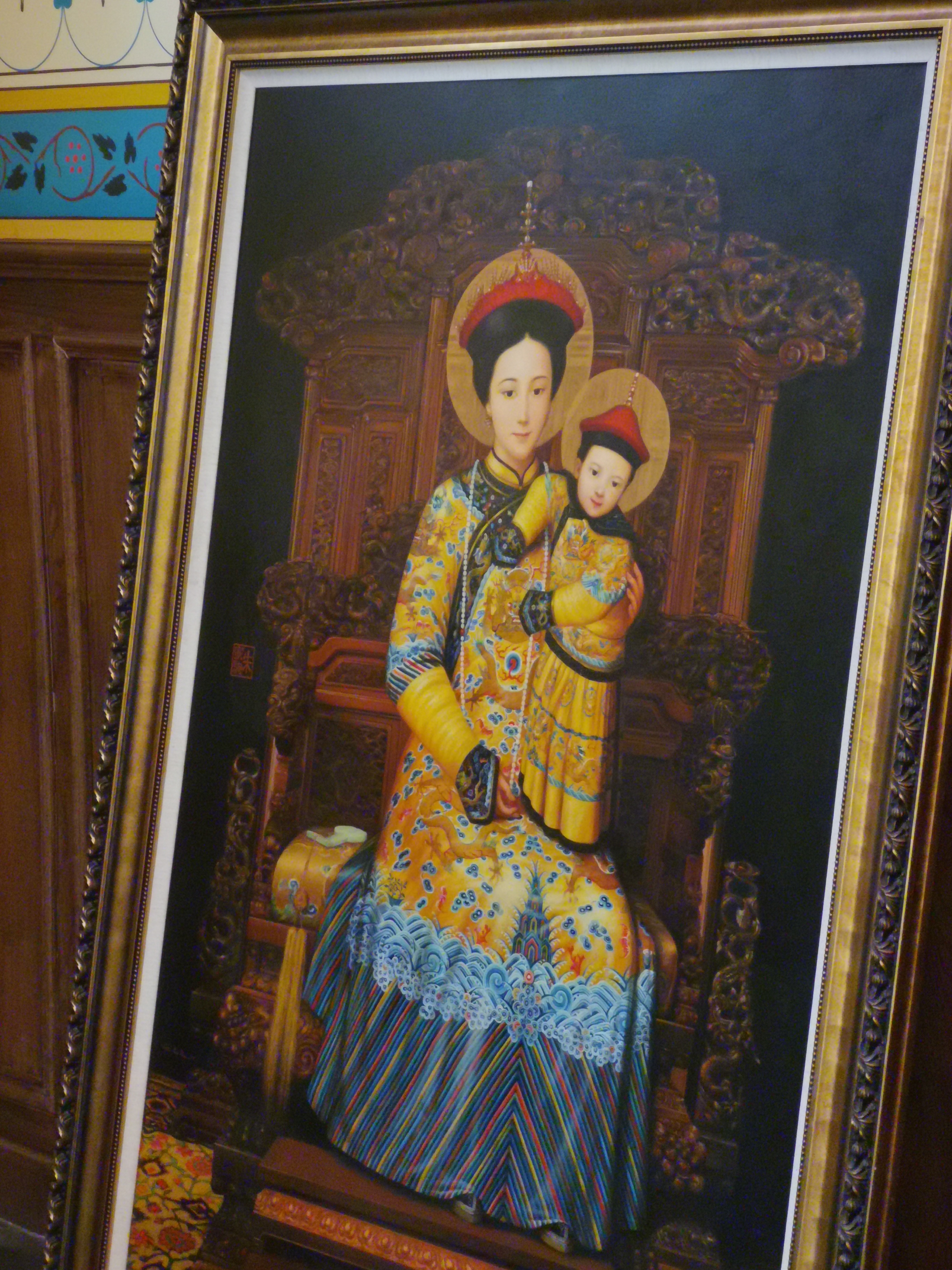
And now this....Manchurian styled Holy Mother and Child statuary and paintings from the Christ Our Savior church's chapel.


Tuesday, July 12, 2022

Why Not To Wear a COVID-19 Mask

Posted July 12, 2022

The post below was written months ago. A week ago I returned from a 22 day European scouting trip for our documentary Angel Quest. During those days I mingled with thousands of people in airports and on planes, train stations and on trains, on ferries, in taxi-cabs, and at pilgrimage sites.  I traveled from the U.S. (Detroit and Boston) to Ireland, England, France, Italy, Greece, and Israel, back to London and then to Detroit in the U.S. Almost no one anywhere I went wore a mask. I never wore a mask except for 20 minutes on a Greek ferry because I was told to in a vacant interior cabin, until I discovered the hundreds of people on the top deck in the sun sans-masks...where I stayed for the rest of the 2 hour trip to Symi Island. I am convinced I am healthy before, during, and after the trip because I have refused all COVID vaccines. Yes, I did have COVID-19 pneumonia in December and January, when my doctor told me I was building anti-bodies. In my case I think Natural Immunity worked better than the vaccines. I have many friends and acquaintances, as does my wife. It seems to us that those that got vaccinated got sick with covid frequently and repeatedly and some died within a week or two of getting their booster shots. Pam and I both got sick once, and that was it. No vaccines, no masks. 


POSTED June 17, 2020

This afternoon I was listening to a call-in show hosted by Guy Gordan on WJR 760 AM Detroit. He was defending Governor Whitmer's order to wear masks in restaurants when you enter and walk around but not when sitting with your party at a table. Patrons around town are objecting to the order, and he was asking for callers to explain to him the resistance. But no one calling in had any reasons for NOT wearing masks other than a rebellious attitude. I'm not good debating on live radio, and the reasons for NOT wearing mask were too many to get across in my 20 seconds, should I get through the call screener. Besides that I was driving and didn't want to further distract myself. So, I'm going to send Guy this link. My response is appropriately on our Imperfectly Human documentary blog. We're all imperfectly human, especially government officials...and some medical experts, when it comes to this covid19 business.

Why NOT to wear covid19 masks...UNLESS you're a member of a health compromised group.

1. SCIENTIFICALLY

There are around 2 billion different bacteria and viruses in the world. The human body is designed to ingest small amounts of them and create a defense against them. This is why kids that eat dirt don’t get sick, yet get healthy instead.

A. If wearing a mask prevents you from getting a little of the germ, you weaken your immune system by wearing the mask. Your natural immune system requires small doses of bacteria and viruses to build up antibodies and antigens to defend the body naturally. To prevent that, through wearing masks and isolation, makes you more vulnerable in the long run and is one of the reasons for there sometimes being a second wave.

B. Our bodies are designed to expel toxins on a regular basis, not just through urination and defecation, but also through the sweat glands via the pores in your skin, and by the expelling of breath.  While this may sound like an argument to wear a mask to save others from breathing in our toxins, wearing a mask keeps those toxins close to your nose and mouth for re breathing, which you don’t want to do.  The simple example is chemical, e.g. the exhaling of CO2 and inhaling of O2.

C. Throughout the whole pandemic cycle the changes of dying form covid19 have been between 0.002 – 0.004 of 1%. That is dramatically lower than just about every other way to die. And yet we’ve destroyed people’s lives because of this. The threat was never scientifically valid, except for those in nursing homes or for people with other serious health issues.

2. LOGICALLY

A. As the CDC is finally admitting, catching a serious dose of the virus requires prolonged contact, such as sitting at a restaurant table for 30 minutes in discussion. You are NOT likely to catch anything walking into a restaurant or walking to the restroom to wash your hands. Thu, the wearing of mask rule in restaurants in irrational and you’re better off not wearing one when walking around. See Item No. 1.

B. There is no rule about wearing protective gloves or using hand sanitizer after handling the door handles to the restaurant or bathrooms. The masks doesn’t help here, and yet sanitizer would.

C. Whitmer’s orders to prevent golf and boating to reduce the spread is irrational and not in the interest of good health. A healthy immune system requires (a) reduced stress, (b) exercise, (c) fresh air, (d) and sunlight (Vitamin D). Golf and boating do all those things, and they do not need to be large group events, clearly golf is not, and even in a foursome can be played easily with social distancing.  These and other examples of her edicts throw into question everything she demands. Most of us are not into irrational tyranny.

D. The so called “experts” including Fauci have been wrong about many issues regarding covid19. To claim that we should be following expert advice when we have never before shut down society or been asked to wear masks in any of the last half-dozen serious flu seasons, reveals that the demand we wear masks now is political.

E. The last I read, those states that did not lock down and demand masks are not fairing worse than those that did.

F. Whitmer claims she’s all about saving lives, but yet she supports abortion lessens her credibility.

G. News media personnel have been caught on camera demanding the president and others always wear a mask, but there are video clips of them removing their masks as soon as they think the cameras are off, and NOT social distancing. This lends credibility to the argument that wearing masks is a hoax.

3. POLITICALLY

A. Trump is role modeling the behavior I’ve outlined above. He doesn’t wear a mask, because it is not healthy to wear one, as well as not being politically smart...it’s not petty to claim he doesn’t want the media to see him, it would be a serious mistake, because it would reinforce that all the panic stricken but ill-informed “experts” would be right. And he knows they’re not.

B. Politicians move the goal posts. It’s no longer about hospital capacity. It’s the “number of cases.” When, in fact, we want everyone in the state to become a “case” so they can build up immunity. We WANT large number of cases, but we’re irrationally told that a high number of cases is bad. Not true. If a vaccine gets developed and everyone takes the vaccine, guess what, EVERYONE would test positive for the virus at some point…and that would be good.

C. You take all this together, and the rules do not make sense. It makes more sense that Democrats have wanted to kill the economy to oust Trump. But everyone seems to want to follow the mask guidelines, even if there is no rational reason for doing so.  

Stan Williams